Quick Answer
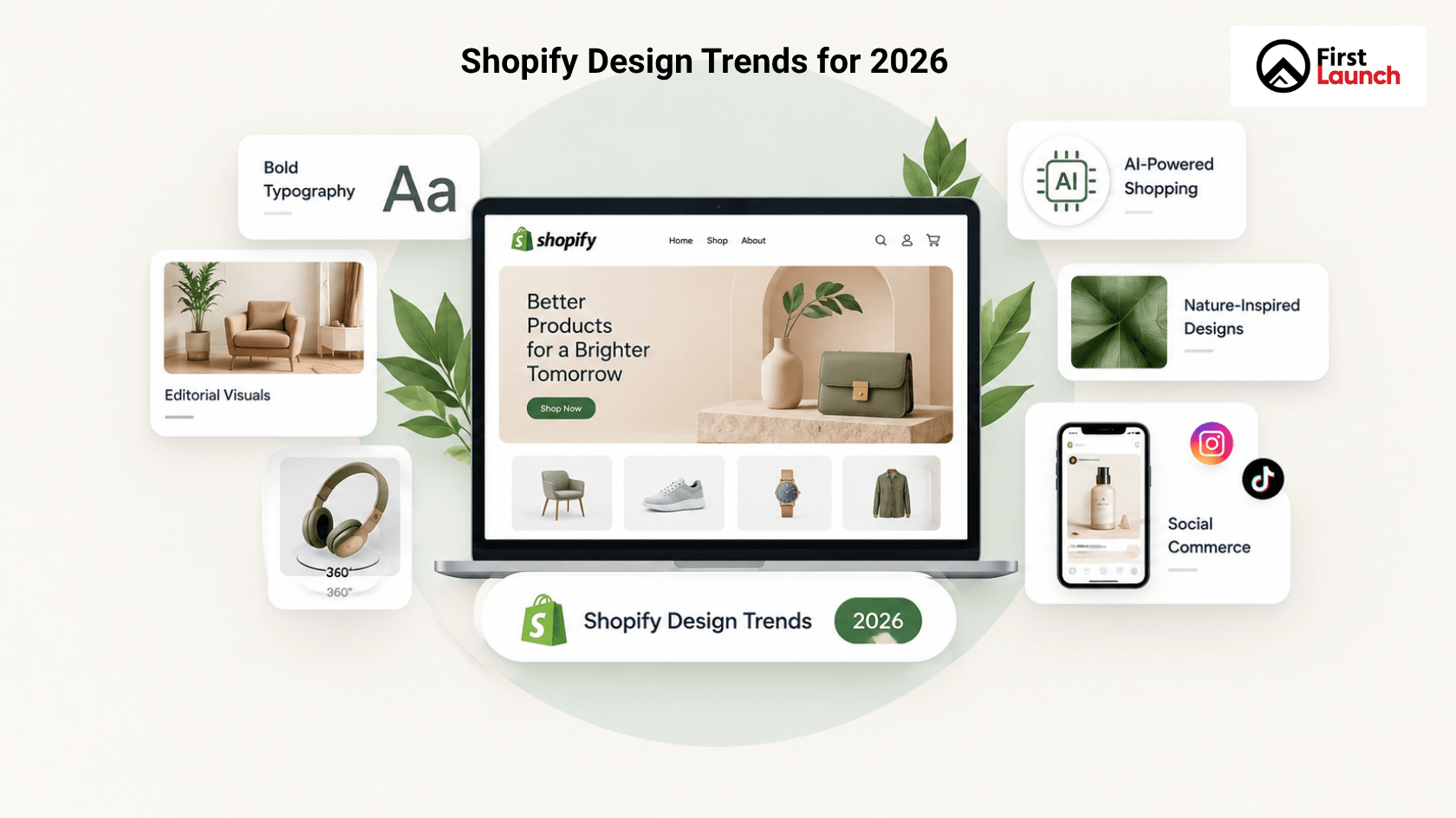
The key Shopify design trends for 2026 include stronger brand-led visuals, editorial product photography, bold typography, immersive product experiences, purposeful animations, flexible layouts, AI-powered shopping experiences, and social commerce. The best trend for your store depends on your products, audience, brand identity, and business goals.
Shopify is evolving, with brands seeking more effective ways to differentiate while providing an easy shopping experience. In 2026, website design is leaving behind ‘pretty’ homepages and pass layouts. In their search for identity, brands are giving consumers more engaging experiences with richer visual storytelling, more memorable product storytelling, intentionally designed type, immersive media, and adaptable storefronts.
A good Shopify site is not just modern. It guides browsing, comparison, and the path to checkout while adding the human element that helps people bond with a brand.
Shopify’s latest design examples show a mix of strong brand identity, lifestyle photography, nature-inspired visuals, nostalgic elements, and product-focused layouts. At the same time, other 2026 trends are pushing merchants toward AI-assisted discovery, 3D product experiences, social commerce, and more flexible storefronts.
Keep an eye on these Shopify design trends for 2026 and learn how to leverage them in your business.
1. More Distinctive Brand-Led Storefronts
One of the biggest shifts in Shopify store design is the move away from websites that all look alike.
Using a popular theme can help a business launch quickly, but relying too heavily on the default layout can make a store feel generic. In 2026, more brands are using their websites to express their personality through photography, typography, colors, illustrations, layouts, and product presentation.
The goal is not to make a website unusual just for the sake of being different. Every visual choice should support the brand.
For example, a premium fashion brand may use large editorial images and generous white space. A food brand may use bright product photography and playful graphics. A natural skincare brand may use earthy colors, organic shapes, and outdoor imagery.
Shopify’s recent examples show how brands use their websites to extend the visual language of their packaging and products.
2. Editorial-Style Product Storytelling
Product photography is no longer limited to showing an item against a plain background.
More ecommerce brands are using editorial and lifestyle photography to show products in context. This gives shoppers a better idea of how a product looks, feels, or fits into their daily lives.
For example, instead of showing a chair against a white background, a furniture brand can show the chair in a finished living room. A fashion brand can show clothing as part of a complete outfit. A food brand can show the product being prepared or served.
Shopify’s 2026 design examples highlight this approach, including brands that use lifestyle settings and visual storytelling to help customers imagine how products could fit into their own lives.
This approach can make product pages more engaging while giving customers useful context before they buy.
3. Nature-Inspired Visuals and Organic Design
As digital experiences become more polished and technology-driven, some brands are moving toward visuals that feel more natural.
Nature-inspired colors, organic shapes, textured backgrounds, natural photography, and handmade-looking details can make a store feel warmer and more human.
Shopify’s 2026 design research identifies a return to nature as one of the visual directions appearing across ecommerce websites. The approach is especially useful for beauty, wellness, food, fashion, home, and sustainable brands.
This does not mean every store needs a green color palette or botanical illustrations.
The more useful lesson is to connect your visual style with the product and brand story. A sustainable business, for example, can use real materials, natural photography, and earthy visual elements to reinforce its positioning.
4. Nostalgia With a Modern Look
Other 2026 trends include a nostalgia revival.
Vintage-inspired typography, film-styled photography, grain filters, desaturated colors, vintage illustrations, and nostalgic visual references can help to establish an instant emotional connection with visitors.
These current Shopify prototype designs illustrate the way brands can tap into those nostalgic visual cues without trying to replicate a traditional old-school website. It’s about taking a little of that nostalgia and applying it freshly.
This can be especially effective for brands with a rich heritage or products that are associated with a specific time period.
However, don’t let nostalgia get in the way of the usability of the brand. Navigation, product information, buttons, checkout, etc. should all be clear.
5. Bold Typography With Better Visual Hierarchy
Typography has become a more important part of Shopify design.
Large headlines, distinctive typefaces, strong contrast between headings and body text, and carefully chosen font combinations can give a storefront a stronger visual identity.
But bigger does not always mean better.
Typography needs to create a clear hierarchy. Visitors should immediately understand the main message, product name, offer, supporting information, and next action.
Shopify’s 2026 UX research also points to more flexible, performance-friendly typography, including variable fonts that can provide multiple styles while reducing the need for separate font files.
For a Shopify store, typography should therefore balance brand expression with readability and performance.
6. Product Pages With More Visual Depth
Product pages are more than just a product image, title, price, and buy button.
More and more buyers want to see a sufficient amount of visual detail of what they are going to buy.
A strong product page can include:
- Multiple product angles
- Lifestyle images
- Short product videos
- Close-up details
- Size or scale references
- Product comparisons
- Reviews and customer images
- Usage examples
- Product specifications
The goal is to beat the customer to the punch.
If you sell a product that’s hard to get a sense of from a photo- size, shape, material, or look-3D and AR might be what you need. Shopify has built-in support for 3D and AR, and this can be especially valuable in the furniture, home decor, fashion, and accessory categories.
Not all stores require 3D models. Apply them to create a real-world product comprehension challenge.
7. More Purposeful Motion and Micro-Interactions
Animation can make a Shopify website feel more engaging, but too much movement can quickly become distracting.
The 2026 approach is more selective. Instead of animating every section, brands can use motion to communicate something useful.
For example:
- A product image can display when a shopper chooses a color.
- Submit buttons can give you a little bit of user feedback after a submission.
- A product gallery can fade between images.
- A navigation menu can open without delay.
- Shopping for content or media.
- A product detail may be displayed when a customer engages with an image.
However, such small touches can enhance the mall’s finished look without taking over the visitor’s experience.
If an animation does not help someone understand, navigate, or interact with the store, it may not need to be there.
8. Flexible Store Layouts Instead of Rigid Templates
Modern Shopify themes give merchants more flexibility to build pages around their products and brand.
This is important because not every ecommerce business needs the same homepage structure.
One brand may need a large product hero section. Another may need a category-led layout. A third may rely heavily on educational content and product demonstrations.
A flexible layout lets businesses choose the sections that support their goals instead of forcing every page into the same template.
This is also where custom development becomes useful. If a standard theme cannot support a specific shopping experience, a development team can create custom sections or functionality.
For businesses considering a new build, a Shopify website development agency can help decide which elements should use standard theme functionality and which require customization.
9. Immersive Product Media
Video, interactive galleries, 3D models, and richer visual content can help customers understand products without reading long blocks of text.
However, immersive media should have a clear role.
A short demonstration video can show how a product works. A 360-degree view can help shoppers inspect an item. A lifestyle video can show how clothing moves or how furniture fits into a space.
The important point is to use media to answer questions that static images cannot answer as effectively.
This approach can also support product storytelling, especially for products where use, texture, movement, or scale is an important part of the buying decision.
10. Design That Supports AI and New Shopping Journeys
AI is transforming how shoppers find products, but the design response isn’t just to add a chatbot to every Shopify store.
Artificial Intelligence in shopping: When AI assists shoppers in discovering important products more quickly.
Examples include conversational product search, intelligent recommendations, guided product discovery, and personalized discovery.
According to Shopify’s current UX guidance, “AI solutions perform best when they remove friction rather than slow down the experience.”
It indicates that product data should be well-structured and easy to understand, so that it is clear for customers and intelligent systems that handle product data. Product name, description, data attributes, categories, etc.
A Well-Made Storefront Enables Both Browsing and Discovery.
11. Design for Social and Multi-Channel Shopping
Shoppers may discover products on social media, creators, marketplaces, and via search engines and other online channels before ever setting foot in the shop.
This makes consistency important.
Your product photography, use of colors, typography, messaging, and overall visual identity on all your channels should feel cohesive.
Social commerce also looms larger in the future of the Shopify ecosystem. Up-to-the-minute Shopify trend predictions for 2026 indicate more comprehensive links between Shopify and social shopping apps to lower customer friction in the bridge between social product discovery and purchasing.
Your website should therefore “feel” like an extension of the brand your customer has already had contact with on some level.
12. Design With Conversion in Mind
A beautiful website is useless if it does not lead customers to decide.
All key design decisions should focus on the buying journey.
Ask:
- How easily do visitors grasp what is being sold?
- Can you easily identify the key products?
- Is the value of each product clear?
- Can shoppers compare products easily?
- Are important details visible without excessive scrolling?
- Are calls to action easy to identify?
- Does the checkout journey feel straightforward?
Good design removes unnecessary decisions.
Particularly for a developing Shopify website, adding more features and products can complicate navigation.
The most beautiful design is not always the most complex. It’s the one that makes a customer feel comfortable and confident walking around the store.
13. Customization Based on Business Needs
Not every business requires a fully customized Shopify storefront.
A niche can be sufficient for a smaller brand with minimal needs if it’s appropriately chosen. The bigger your business is, the more you’ll be able to benefit from customization, as your store will need a unique shopping experience, more sophisticated product setup, advanced merchandising, and customized integrations, etc.
This is why Shopify website costs can vary significantly between projects.
The end price can be raised by:
- Theme selection
- Level of customization
- Number of page templates
- Custom functionality
- Third-party integrations
- Product complexity
- Apps and subscriptions
- Design requirements
- Development hours
- Ongoing maintenance
The right way isn’t always the best, in terms of how much is spent on design. The right way is to put your money into where it will most affect both customers and the business.
How to Choose the Right Shopify Design Trends
You do not need to adopt every trend in 2026.
Start by reviewing your current store.
Look at where customers drop off, which pages receive the most traffic, which products perform well, and where shoppers seem to face friction.
Then choose trends based on your business.
A fashion brand may benefit more from editorial photography and stronger typography. A furniture store may gain more from 3D product visualization. A premium lifestyle brand may benefit from tactile textures and distinctive storytelling.
If your existing website already performs well, small design improvements may be more valuable than a complete redesign.
A Shopify website development agency can help assess your existing store and determine where customization or redesign can create measurable value.
What to Avoid When Following Shopify Design Trends
Trends can improve a website, but following them without considering your customers can create the opposite result.
Avoid:
- Adding animations simply because they look impressive
- Using oversized text that makes pages difficult to scan
- Replacing useful navigation with experimental menus
- Adding too many pop-ups
- Using large videos that slow down pages
- Copying another brand’s visual identity
- Adding 3D or AR features without a clear purpose
- Choosing a theme based only on its homepage demo
- Changing a familiar layout without testing the impact
A trend should solve a problem or strengthen the brand. If it does neither, it may not belong on the website.
Shopify Design Trends Checklist for 2026
Before updating your store, review these areas:
- Does the design reflect your brand identity?
- Are products shown in useful real-world contexts?
- Is the typography clear and consistent?
- Does the visual hierarchy guide shoppers naturally?
- Are product pages visually informative?
- Are animations used with purpose?
- Does the theme allow enough customization?
- Are images, videos, and interactive elements optimized?
- Is the design consistent across social and ecommerce channels?
- Are new technologies solving a real customer problem?
- Does the design support product discovery and conversion?
- Is the website easy to maintain as the business grows?
Final Thoughts
The best Shopify store design trends for 2026 are not about making an ecommerce store look futuristic. They are about creating a stronger connection between brand, product, and customer.
Distinctive visuals, editorial photography, thoughtful typography, immersive product content, flexible layouts, and selective use of new technology can help a Shopify store stand apart without making the shopping experience complicated.
The right design will depend on your products, audience, brand, and growth goals. If you are planning a new store or redesigning an existing one, contact First Launch to discuss your Shopify website design and development requirements and build an ecommerce experience around your business goals.
Frequently Asked Questions
What are the latest Shopify design trends for 2026?
The major Shopify design trends for 2026 include bold typography, distinctive brand-led designs, editorial product photography, nature-inspired visuals, immersive product media, purposeful animations, flexible layouts, AI-powered shopping experiences, and social commerce. Businesses should choose trends that improve the shopping experience rather than simply following what is popular.
How can I improve my Shopify store design?
Start by reviewing your current website from a customer’s perspective. Improve your visual hierarchy, product photography, typography, navigation, product pages, and calls to action. Make sure the design reflects your brand while keeping product discovery and purchasing simple. You can then introduce features such as interactive media or personalized recommendations where they provide real value.
How much does Shopify website design cost?
Shopify website cost depends on factors such as the theme, level of customization, number of pages, custom features, integrations, apps, and development requirements. A basic theme-based store may require less investment, while a fully customized Shopify website with advanced functionality will generally cost more.
Is custom Shopify design better than using a theme?
Neither option is automatically better. A Shopify theme can be a practical choice for businesses that need to launch quickly with standard ecommerce features. Custom Shopify design can be more suitable when a brand needs a unique visual identity, specialized functionality, or a shopping experience that standard themes cannot provide easily.
Should I redesign my Shopify website in 2026?
A redesign may be worth considering if your Shopify website looks outdated, performs poorly on mobile, has difficult navigation, does not reflect your current brand, or makes it harder for customers to find and purchase products. Before redesigning, identify the specific problems you want the new design to solve rather than changing the website simply to follow a trend.

