
What Really Happens When a Google Ads Campaign Pauses
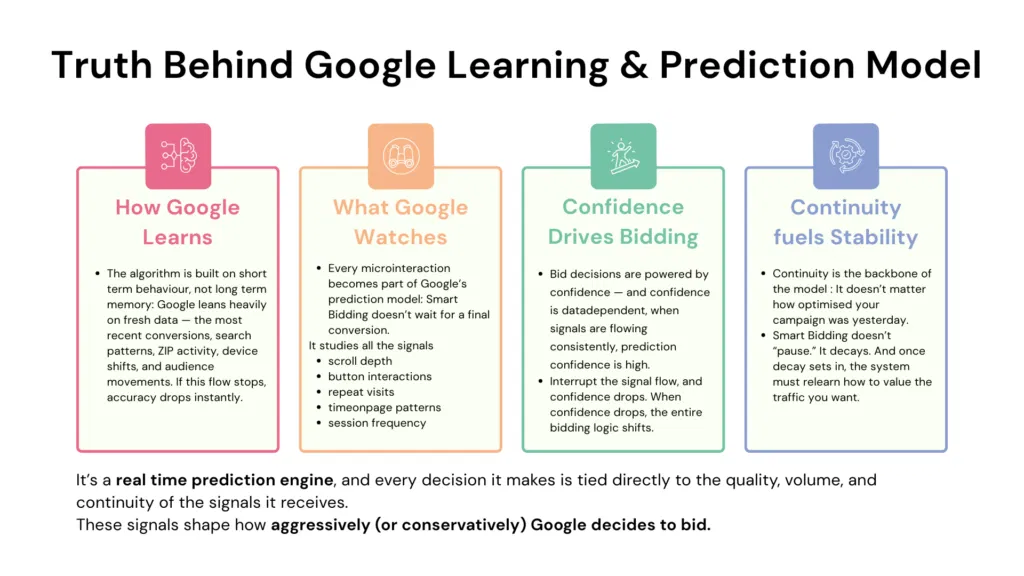
Google Ads doesn’t run on fixed rules.
It runs on a constant stream of live signals that power Smart Bidding, prediction accuracy, user-value modelling, and auction strength.
Every click, scroll, session pattern, device shift, ZIP-level activity, and micro-engagement feeds into how the system decides:
- Which auctions do you enter
- how aggressively you bid
- the value of each user
- What traffic quality do you receive
- and how efficiently your budget is spent
When this signal stream is uninterrupted, Google builds a clear, confident understanding of how users interact with your business.
High confidence produces stable CPC, predictable impressions, and consistent conversion paths.
But when that continuity breaks, Google’s model must rebuild its understanding of intent, value, and competitiveness — and that rebuilding phase is exactly where most performance fluctuations originate.
This blog explains how Google interprets signals, what forms the backbone of Smart Bidding accuracy, and why even brief disruptions force the algorithm into a relearning cycle that impacts costs, traffic patterns, and recovery speed.
How Google Ads actually learns and builds its prediction model
The 4 Critical Systems Smart Bidding Loses the Moment Delivery Stops
| System That Breaks | What Google Loses | How it Impacts |
| 1. Live Signal Flow | No new conversions, no query intent data, no ZIP-level activity, no microengagement signals. | Google’s model becomes blind to current user behaviour. When signals stop, accuracy collapses. |
| 2. Prediction Confidence | Google stops trusting its own forecasts — who will convert, what clicks are worth, and how aggressively to bid. | Low confidence forces Google into defensive bidding: CPC rises, impressions become unstable, CTR softens. |
| 3. User Value Modeling | The system can no longer distinguish high-value users from low-value users based on fresh behaviour. | Google must rebuild the value map from scratch, which slows down conversions and increases learning time. |
| 4. Auction Memory & Positioning | Google loses your recent performance footprint in auctions — your relevancy, competitiveness, and win-rate trends. | You re-enter auctions from a weaker position, triggering exploration, spikes in spend, and CPC inflation. |
How Google Auction Entry Changes When Your Campaign Resumes
When a paused campaign comes back online, Google does not place it back where it left off.
It reenters the auction system with reduced confidence and reduced priority — and that single shift drives almost all postpause volatility.
What Happens to Auction Entry After a Pause
| Auction Behaviour After Resuming | What Google Does Differently | What You See in Performance |
| 1. You Lose Premium Auction Access | Google stops putting you into the high-value, high-intent auctions you previously dominated. | Sudden drop in conversion quality, weaker traffic, and slower recovery. |
| 2. You’re Pushed Into Exploratory Auctions | Google tests broad queries, new ZIPs, new audiences, and cheaper placements. | Lower CTR, inconsistent impressions, rise in “irrelevant” traffic. |
| 3. Google Bids Conservatively | With low confidence, it avoids aggressive bids. | CPC increases, top of page rate decreases, and impression share becomes unstable. |
| 4. Competitors Have a Data Advantage | Their continuous activity keeps their prediction scores high. | They win more auctions while you “catch up,” raising your costs. |
| 5. Google Forces a Relearning Auction Cycle | The system behaves as if you launched a new campaign, even if nothing changed. | Spend spikes as Google collects fresh data to rebuild your position. |
Why Auction Entry Matters More Than Any Other Factor
Every metric shift after a pause — higher spend, CPC inflation, CTR dips, impression swings — can be traced back to how you reenter the auction.
This is the hidden layer of Google Ads that few marketers talk about, but it determines:
- Your placement
- Your cost efficiency
- Your conversion quality
- Your recovery speed
Understanding auction entry is the key to understanding post-pause performance behaviour.
Search vs PMax: How Each Reacts When a Campaign Pauses
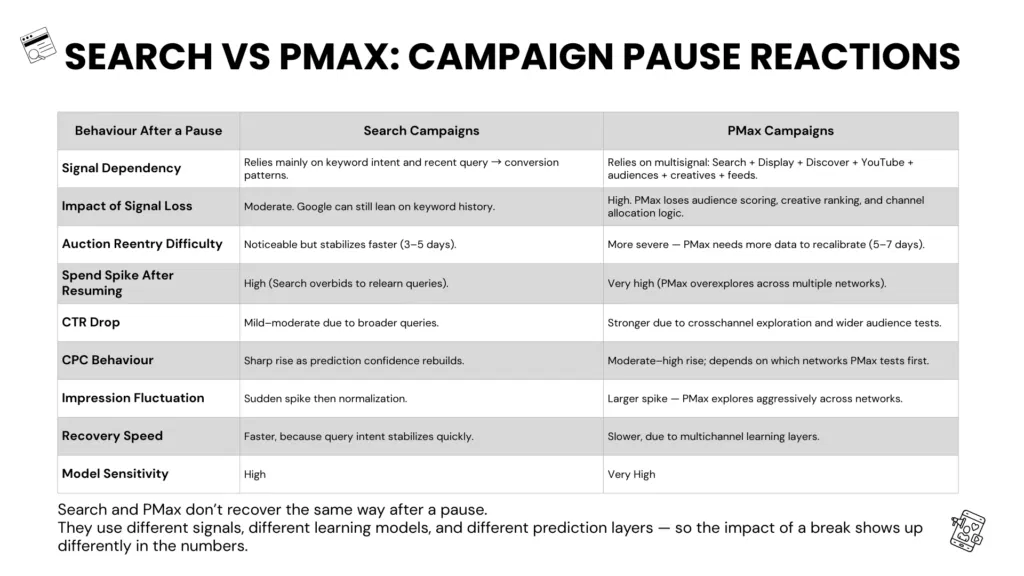
Real World Metrics: What Actually Changes After a Pause
PMax Campaign — Before vs After Pause
| Metric | Before Pause | After Pause | What This Indicates |
| Spend | 45.00 | 297.44 | PMax accelerates learning aggressively across channels. |
| Impressions | 1045 | 5466 | Multi-Network exploration kicks in hard. |
| Clicks | 38 | 177 | High initial exploration volume. |
| CTR | 3.64% | 3.24% | Wider, less qualified reach reduces engagement. |
| Avg CPC | 1.18 | 1.68 | Bids rise to gather fresh cross-network signals. |
PMax experiences a deeper reset than Search because it has more models to rebuild audience scoring, creative performance ranking, channel distribution, etc.
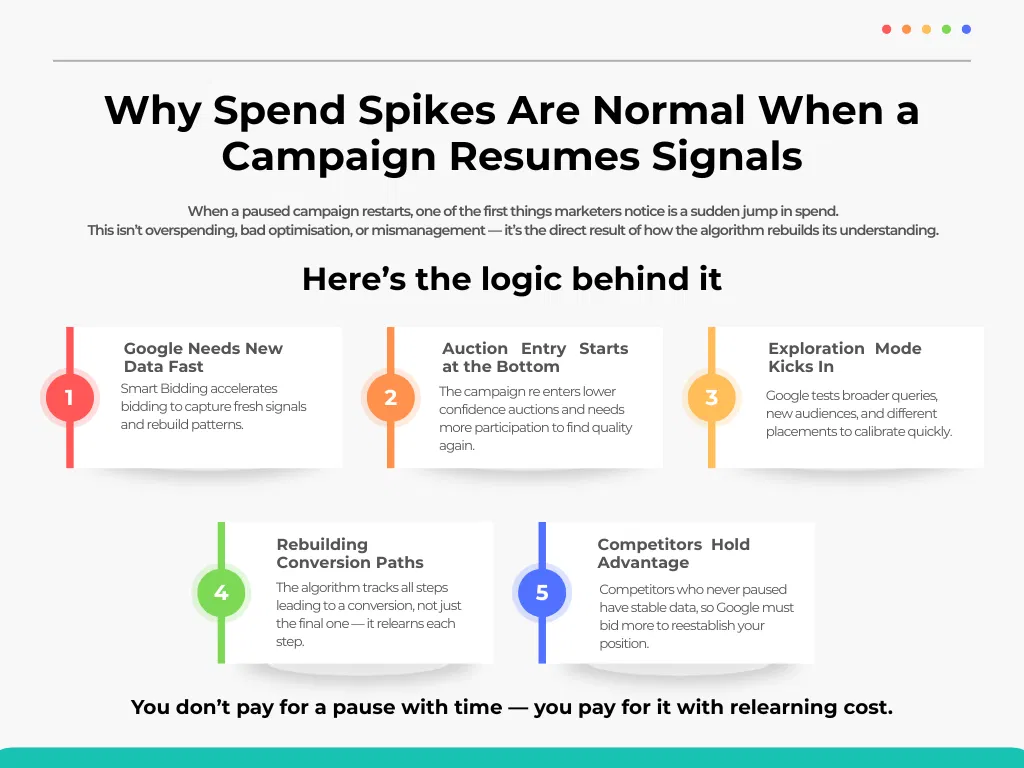
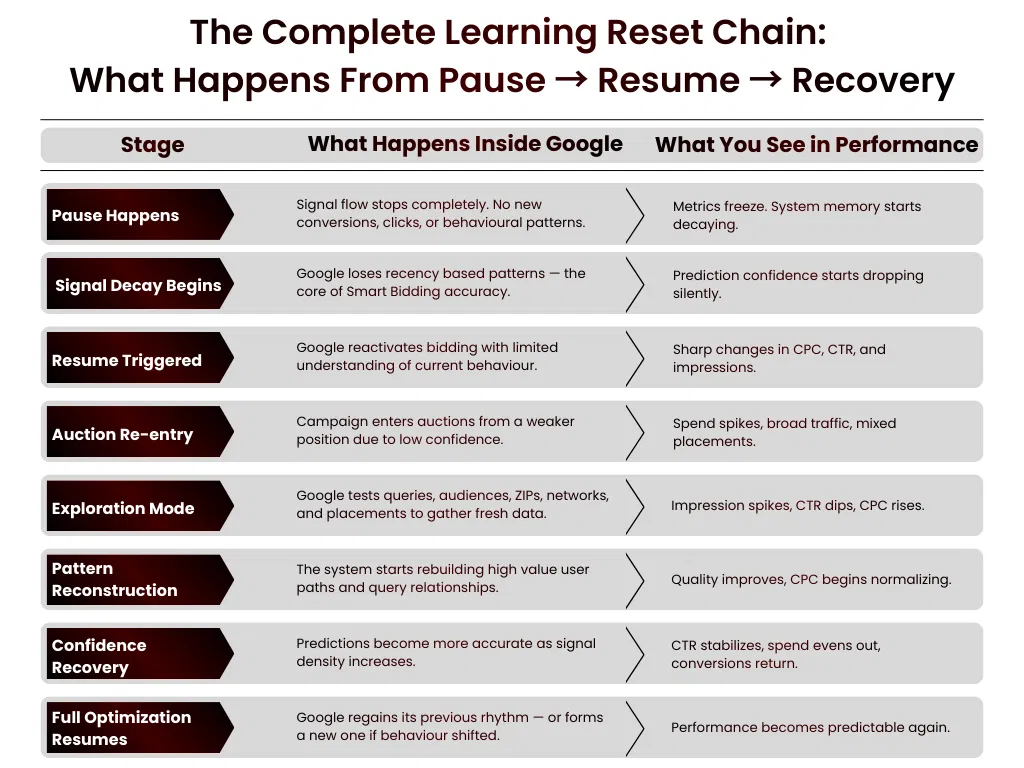
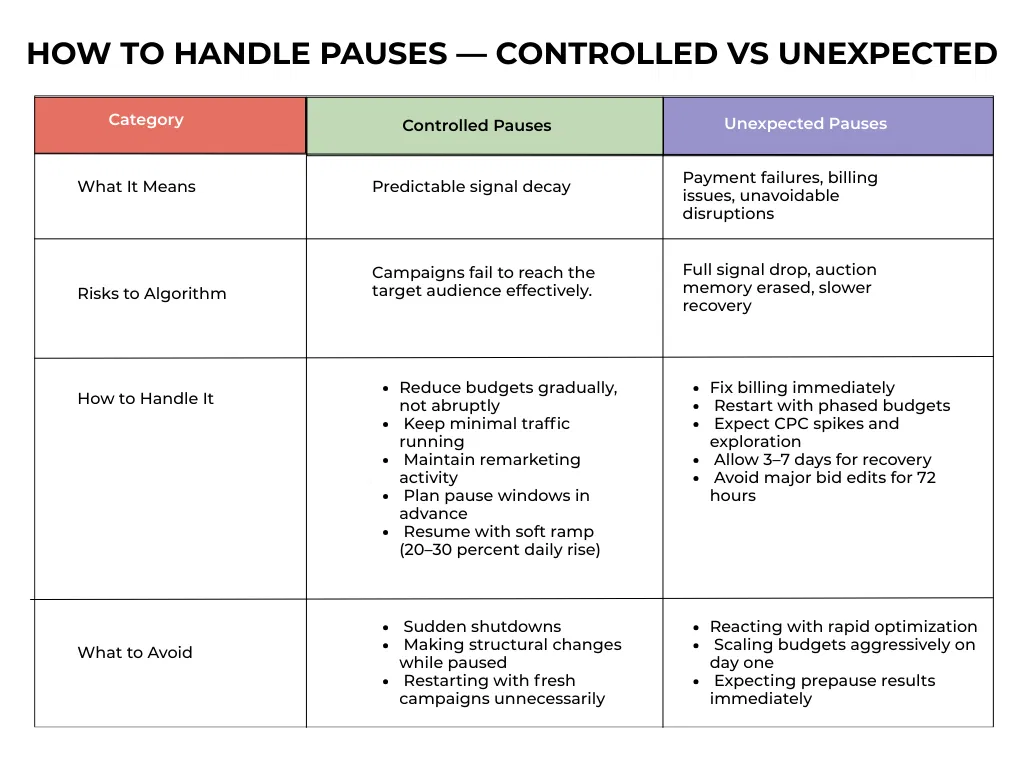
Pauses don’t damage performance by themselves. The real impact comes from how the pause is handled and how the campaign re-enters the auction system. Controlled pauses protect signal flow and reduce recovery cost. Unexpected pauses increase relearning time because the system restarts with incomplete data. Managing the environment around the pause is what determines how quickly Smart Bidding stabilizes again.
Conclusion
Pauses don’t threaten growth. Losing algorithmic continuity does.
When delivery stops, Smart Bidding loses the live signals that shape intent, value, and auction strength.
When you return, the system isn’t unstable — it’s recalibrating.
Technical Expertise is knowing how to guide that recalibration:
- Keep the signal alive: Maintain even minimal activity so the model never resets fully.
- Prepare the pause, prepare the return: Controlled ramps protect auction strength and keep costs steady.
- Avoid shocks on restart: No structural edits, no aggressive scaling, no fresh rebuilds.
- Let the algorithm relearn cleanly: Confidence comes back fast when you give it the conditions it needs.