
You’re posting every day. You’re getting likes. Maybe even a few comments. But your DMs are empty, your website traffic is flat, and your sales pipeline looks like a desert.
Does that sound like you?
The truth is that most businesses think that social media is a megaphone. They think that if they just post enough stuff, something will stick. The problem is that social media is a conversion machine. The difference between a brand that just “exists” on social media and a brand that actually drives revenue? A real social media strategy that’s based on a funnel.
What Does “Converting” on Social Media Actually Mean?
Before getting into the strategy, it’s important to understand what a conversion really is. A conversion isn’t only about making a sale. It’s any action that moves someone one step closer to becoming a customer. That might look like:
⦁ Clicking a link to visit your website
⦁ Signing up for your email list
⦁ Scheduling a discovery call
⦁ Sending you a DM to ask about your services
⦁ Making a purchase
Many businesses focus on vanity metrics like likes, followers, and impressions. While those numbers can feel good, they don’t necessarily translate into revenue. A social media strategy that truly converts focuses on actions that directly contribute to business growth.
“Social media ROI isn’t about likes, it’s about leads, bookings, and revenue.”
Step 1: Understand the Social Media Funnel
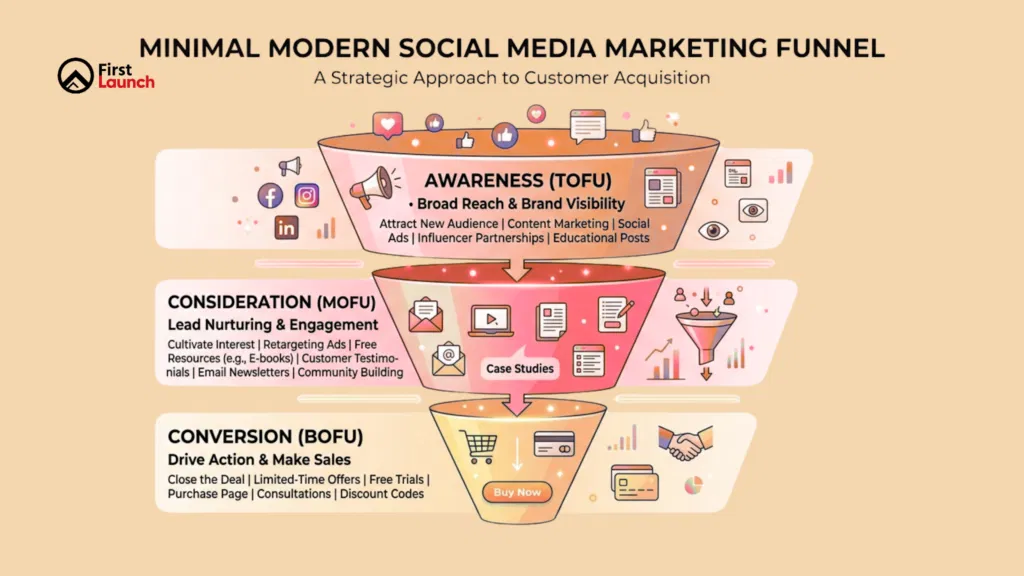
At the core of any social media strategy that actually converts is funnel-based thinking. Just like a traditional sales funnel, your social media content should guide people through different stages of the journey before they become a customer.
Top of Funnel (TOFU) — Awareness
At this stage, people don’t know who you are yet. Your main goal is simply to get on their radar and spark interest in what you do. Content that usually works well here includes:
⦁ Educational reels or short-form videos
⦁ Trending audio with your brand’s unique take
⦁ Relatable memes within your niche
⦁ Behind-the-scenes content
⦁ Thought leadership posts
Middle of Funnel (MOFU) — Consideration
Now your audience knows you exist. The focus shifts to building trust and showing the value of what you offer. Helpful content at this stage includes:
⦁ Case studies and real client results
⦁ Carousel posts with step-by-step tips
⦁ Comparison posts (your solution vs. the problem)
⦁ FAQ content and myth-busting posts
⦁ Testimonials and social proof
Bottom of Funnel (BOFU) — Conversion
This is where you invite your audience to take action. They already trust you now it’s time to make the next step clear and easy. Content that performs well here includes:
⦁ Limited-time offers or promotions
⦁ Direct pitch posts with a strong call-to-action
⦁ Story polls that lead to a sales link
⦁ DM-to-book campaigns
⦁ Free consultation offers
💡 Pro Tip
A simple way to balance your content is the 60/30/10 rule:
• 60% TOFU (awareness)
• 30% MOFU (trust-building)
• 10% BOFU (direct conversion)
This keeps your content valuable and engaging without making your feed feel overly sales-focused.
Step 2: Define Your Audience Before You Post Anything
Every high-converting social media strategy starts with one thing: clear audience understanding. If you don’t know exactly who you’re speaking to, your content will feel generic and generic content rarely converts.
Before creating posts, ask yourself a few key questions:
⦁ Who is my ideal client? (Age, job, income, pain points)
⦁ What problems are they searching for online late at night?
⦁ What kind of content do they already engage with?
⦁ Which platform do they spend the most time on?
⦁ What objections might stop them from buying?
Once you have these answers, every piece of content you publish should address a specific pain point, desire, or question your ideal audience has. That level of clarity is what separates average social media accounts from the ones that consistently generate leads and clients.
Step 3: Build a Content Mapping Strategy
Content mapping is simply the process of aligning your social media posts with the different stages of your audience’s buyer journey.
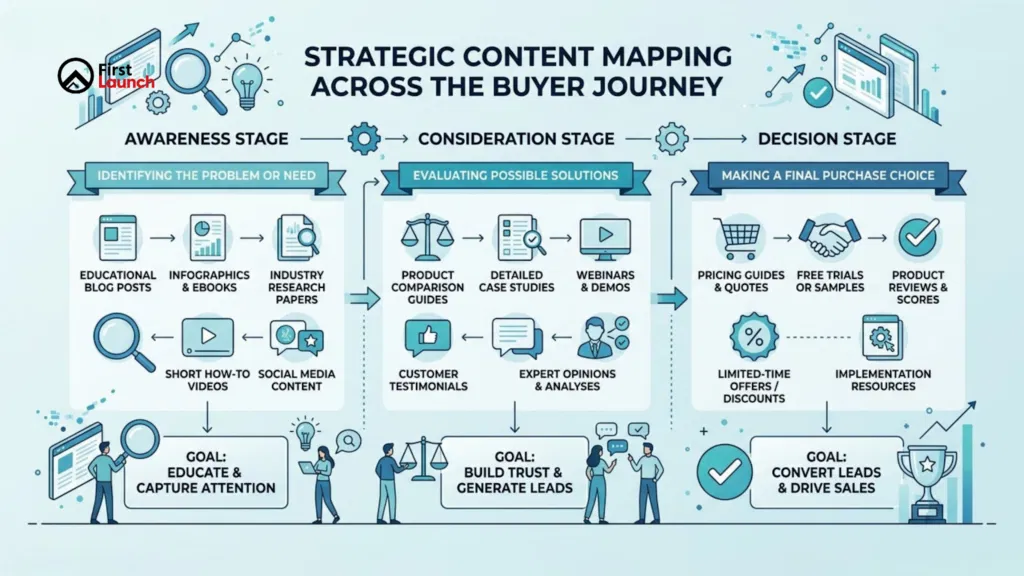
Instead of posting randomly or just following trends, each piece of content has a clear purpose whether it’s attracting new people, building trust, or encouraging someone to take action.
Here’s how to map it out:
| Funnel Stage | Content Goal | Example Content |
| TOFU (Awareness) | Get discovered, educate | “5 reasons your social media isn’t growing” |
| MOFU (Consideration) | Build trust, show expertise | “How we got a client 10x ROI in 60 days” |
| BOFU (Conversion) | Drive action and sales | “Book your free strategy call this week” |
Once your content is mapped, create a content calendar with specific post types scheduled for each week. Consistency beats creativity every single time.
Step 4: Write CTAs That Actually Get Clicked
Your call-to-action (CTA) is what connects your content to real results. It’s the moment where someone goes from simply consuming your content to actually taking the next step.
The problem? Many businesses either forget to include a CTA or rely on vague ones like “Check the link in bio.” That alone usually isn’t compelling enough.
Strong CTAs typically follow a simple formula:
Action Verb + Clear Benefit + Urgency or Ease
Here’s what that looks like in practice:
Weak: “Click the link in bio.”
Strong: “Grab your free social media audit — link in bio. It only takes 2 minutes.”
Weak: “Contact us today.”
Strong: “Book a free 20-minute strategy call and walk away with a clear content plan.”
Weak: “Follow for more tips.”
Strong: “Follow us for daily social media strategies that actually help grow your business.”
Make sure your CTA appears at the end of your captions, Reels, and stories. Just as important, it should match where your audience is in the funnel. If someone just discovered you, asking for a big purchase right away may feel too pushy.
Step 5: Choose the Right Platforms (Not All of Them)
A common mistake businesses make is trying to show up on every platform at once. The result? Burnout and mediocre results everywhere.
Instead, focus on one or two platforms where your ideal audience already spends their time and build real momentum there first.
Here’s a quick breakdown:
⦁ Instagram & TikTok — Great for visual brands, lifestyle content, B2C businesses, and younger audiences
⦁ LinkedIn — Ideal for B2B companies, consultants, professional services, and high-ticket offers
⦁ Facebook — Works well for local businesses, community-driven brands, and audiences 35+
⦁ YouTube — Perfect for long-form educational content, SEO growth, and expert positioning
⦁ Pinterest — Strong for e-commerce, design, food, DIY, and evergreen content
The key is simple: choose platforms based on where your audience already is not just where you enjoy posting.
Step 6: Track the Metrics That Actually Matter
If you’re only looking at likes and follower counts, you’re missing the bigger picture. Those numbers can look impressive, but they don’t always translate into business growth.
A social media strategy that converts focuses on metrics tied to real outcomes, such as:
⦁ Click-through rate (CTR): Are people actually clicking your links?
⦁ Profile visits: Are viewers interested enough to learn more about you?
⦁ Link-in-bio traffic: Is social media sending visitors to your website?
⦁ DM inquiries: Are people reaching out because of your content?
⦁ Lead form submissions: Are your campaigns capturing leads?
⦁ Conversion rate: What percentage of social traffic turns into paying customers?
Review these numbers monthly. If a certain type of post consistently drives clicks or DMs, create more of that content. If something isn’t performing, it’s okay to let it go.

Step 7: Optimize, Test, and Iterate
The most effective social media strategies are never “set and forget.” They evolve over time based on real data.
Each month, review your performance and ask questions like:
- Which posts received the most saves and shares? (High value content)
- Which CTAs had the best click-through rates?
- Which platform brought the most traffic or leads?
- What topics sparked the most comments or DMs?
- What does my follower-to-inquiry conversion rate look like?
You can also run simple A/B tests on things like your hooks, CTAs, and posting times. Small improvements in these areas can lead to major gains in conversions over time.
Final Thoughts: From Posting to Profiting
Creating a social media strategy that actually converts isn’t about posting more content, it’s about posting with intention.
When your content aligns with the buyer journey, fits into a clear funnel, uses strong CTAs, and is measured with the right metrics, social media stops feeling like a time drain. Instead, it becomes one of your most reliable lead-generation channels.
The brands winning on social media aren’t necessarily the ones with the biggest followings. They’re the ones with the clearest strategy.
Ready to Build Your Social Media Strategy That Actually Converts?
At First Launch – Digital Marketing Agency we help brands move beyond disconnected posting and create compelling, unified narratives that work across Instagram, LinkedIn, YouTube, and beyond.
If you’re ready to turn your social media channels into chapters of one powerful story let’s talk. We’ll help you map your narrative, connect your content, and build a social strategy that people actually follow.
Written by Suchitra Anand.