“Manual bidding gives control. Smart Bidding gives speed. Knowing when to choose which is the real skill.”
Google Ads has evolved dramatically over the years – from manual bidding to automated bidding, and now to advanced Smart Bidding powered by machine learning. But with this evolution comes confusion:
What exactly is Smart Bidding? How is it different from automated bidding? Why does it work for some advertisers but fail for others?
This blog takes you through the full journey – from basic bidding concepts to the realities and limitations of Smart Bidding – in one cohesive flow.
Understanding the Basics: What Are Bidding Strategies in Google Ads?
Every time your ad enters an auction, Google determines whether to show your ad and how much to charge you.
Your bidding strategy tells Google how to bid on your behalf.
In simple terms:
A bidding strategy = instructions about how much you want to pay and what you want to achieve.
There are two broad categories:
- Manual bidding
- Automated and Smart Bidding
Manual Bidding vs Smart Bidding
Many marketers wonder which is better – and the truth is, both have their place.

Smart bidding is strong when your account has enough data. Manual bidding helps when the campaign needs tighter control or data is limited.
Practical Examples of Smart Bidding in Action
Example 1: Target CPA
You tell Google: “Bring me leads at ₹300.”
Google adjusts bids to aim for that average cost.
Example 2: Target ROAS
You tell Google: “For every ₹1 spent, bring back ₹4 in revenue.”
It increases bids for profitable users and reduces bids for weak audiences.
Example 3: Maximize Conversions
Google tries to drive as many conversions as possible within your budget, usually spending aggressively.
These examples help beginners understand why Smart Bidding became popular.
When You Should Use Smart Bidding
Smart bidding can work beautifully when the right conditions are in place. It’s ideal when:
- You have at least 15–50 conversions per month
- Your tracking is accurate
- Your budget is stable
- Your campaign has clear goals (CPA/ROAS)
- Your landing page is optimised
- You want to scale performance
If your campaign lacks data or has tracking issues, smart bidding may deliver inconsistent or expensive results.
How to Use Smart Bidding Inside a Campaign
Here’s the simple flow:
- Select your campaign type (Search, Performance Max, etc.)
- Ensure tracking is clean and enhanced conversions are enabled.
- Choose your campaign objective (Sales, Leads, Traffic).
- Pick a Smart Bidding strategy under “Bidding.”
- Set a target only if your data supports it (CPA/ROAS).
- Give the campaign time to learn 7–14 days minimum.
- Avoid frequent edits that reset the learning phase.
When the foundation is strong, smart bidding becomes more reliable and efficient.
Why Smart Bidding Isn’t Always Smart
Despite the hype, Smart Bidding isn’t magic. It’s machine learning and machine learning is only as smart as the environment you provide.
Here’s where it commonly fails.
1. Smart Bidding Needs Good Data
Smart bidding depends heavily on conversion history.
If tracking is poor, the machine receives the wrong signals.
Common issues that break smart bidding include:
- Duplicate conversions
- Wrong primary conversion action
- Missing enhanced conversions
- Under-reporting or over-reporting
- Delayed tracking
A machine is only as smart as the data you give it.
2. Smart Bidding Can Reduce Reach
Smart bidding tends to optimise for users who have already converted before.
This often reduces new audience exploration.
Impact:
- Fewer new customers
- Slow scaling
- Smaller top-of-funnel
This is why many brands see results plateau after a few months of automation.
3. Smart Bidding Lacks Transparency (The Black Box)
Google does not reveal:
- How bids are adjusted
- Which signals matter most
- Why costs spike
- Why conversions drop
This makes troubleshooting harder for advertisers who rely heavily on data analysis.
4. Wrong Signals Can Break the System
If your conversion is set as “button click” instead of “lead submitted”, smart bidding will optimise for clicks, not leads.
Examples of signals that mislead the algorithm:
- Marking secondary actions as primary
- Tracking form views as conversions
- Over-counting page visits
- Using overly broad goals
The machine does not know your business, it only knows the signals you feed it.
5. Smart Bidding Can Spend Aggressively
Strategies like Maximise Conversions aim to spend your full budget, and sometimes quickly.
You may see:
- Sudden CPC increases
- Spending in expensive auctions
- Full-day budgets exhausted early
- Poor quality traffic during learning
If you are a small business or have tight daily budgets, this can become risky.
How to Get the Best Out of Smart Bidding
Smart Bidding works wonderfully when you set it up correctly.
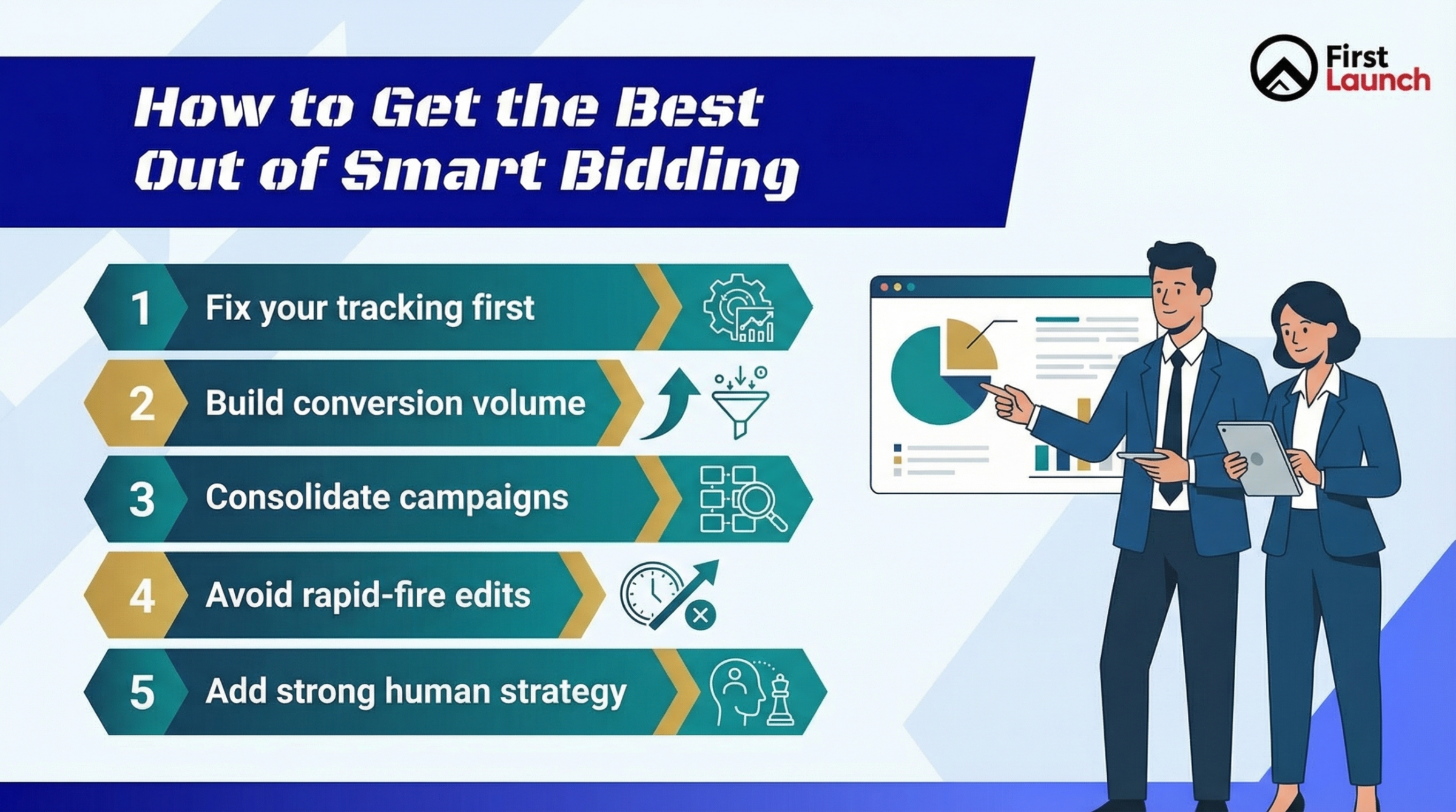
The best practices:
1. Fix your tracking first
Clean conversions, enhanced conversions, correct attribution.
2. Build conversion volume
Even 15-30 good conversions per month help the algorithm stabilize.
3. Consolidate campaigns
Avoid over-splitting, let data pool together.
4. Avoid rapid-fire edits
Let campaigns complete learning before tweaking.
5. Add strong human strategy
Automation needs good creatives, strong landing pages, and a logical account structure.
Smart Bidding optimizes bids, not your whole business.
Conclusion
Smart Bidding in Google Ads offers a powerful way to automate bidding and improve performance, especially when your campaign has strong data and clear goals. But like any machine, it works only as well as the inputs you give it. When tracking is inaccurate, conversion volume is low, or goals are unclear, smart bidding can become unpredictable and expensive.
The most effective approach is a balance: human strategy combined with machine execution. When the two work together, smart bidding becomes a valuable tool that can genuinely scale your marketing efforts in India.
First Launch bridges that gap. As a leading performance marketing agency in Bangalore, we help brands fix tracking, build scalable campaigns, and use Smart Bidding the right way – not blindly. Work with us and turn Smart Bidding into real business growth.

