Every business talks about performance, growth, retention, customer loyalty, culture, and all the popular buzzwords floating around the corporate world. Yet Maslow’s Hierarchy of Needs reminds us of a simpler truth: people do the work, people buy the product, and people decide whether your brand is worth their time.
That is why Maslow’s hierarchy still shows up in business schools, leadership workshops, and marketing playbooks. Not because it is a fancy model, but because it reminds businesses of something we often overlook. Human needs drive every choice we make. When a company learns how to meet these needs, employees work better, customers trust more, and the business becomes something people want to be part of.
So this guide is not just a lesson in psychology. It is a practical breakdown of how Maslow’s Pyramid actually influences business, marketing, teamwork, and customer behaviour today.
Let’s start with the basics.
What is Maslow’s Hierarchy?
Maslow’s hierarchy is a motivational theory that explains why humans behave the way they do. It is visualised as a pyramid with five stacked levels of needs. The lower levels represent basic survival needs. As each level is fulfilled, a person naturally shifts attention to the next level.
People move from survival to safety, then to connection, then to confidence, and eventually towards purpose and fulfilment. Businesses often apply this model to understand employees and customers because it reveals a simple truth. If a lower need is not met, people rarely care about higher ones.
Before we dive into the business angle, let’s see where this model came from.
The Origin of Maslow’s Hierarchy
Abraham Maslow introduced his theory in 1943. At the time, psychology focused heavily on illness and dysfunction. Maslow flipped the script by studying what makes people thrive. His research shaped a new era of humanistic psychology. Instead of asking why people break down, he wanted to know why people grow.
Although his model was originally academic, it quickly caught the attention of businesses that were trying to understand motivation, teamwork, and leadership. Even today, organisations across the world use Maslow’s hierarchy to create better workplaces and stronger customer relationships.
Different Types of Needs in Maslow’s Pyramid
Maslow identified five categories of human needs. These categories represent what every person seeks, whether consciously or not.
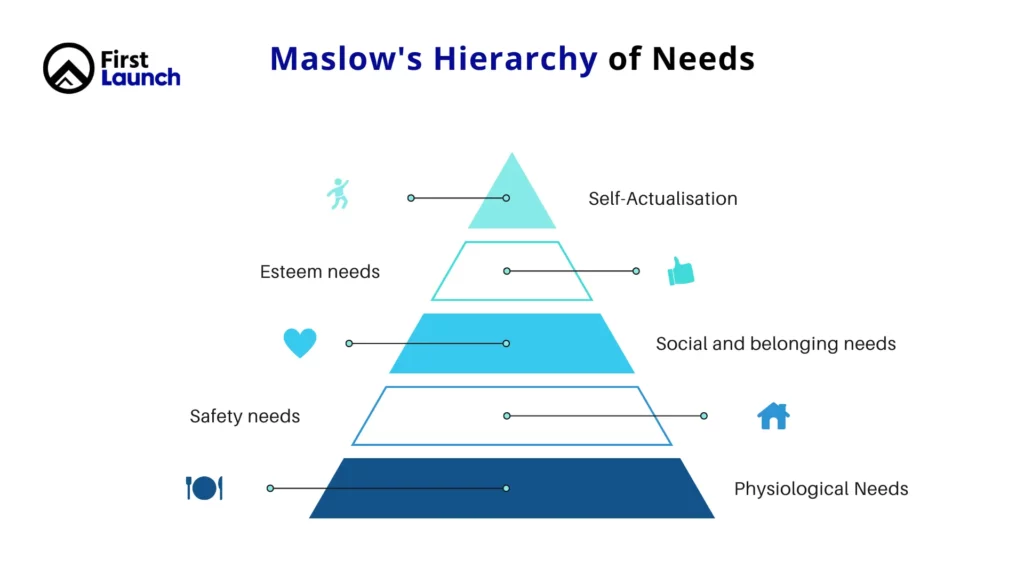
1. Physiological needs
Food, sleep, rest, energy, physical comfort.
In business, this relates to fair pay, manageable workloads, basic equipment, and a healthy environment.
2. Safety needs
Security, predictability, stability.
At work, this includes job security, clear expectations, and feeling protected from harm or unfair treatment.
3. Social and belonging needs
Friendship, connection, community.
People want to feel included and supported. Teams and customer communities fulfil this layer.
4. Esteem needs
Respect, recognition, confidence, achievement.
Employees want acknowledgment and growth. Customers want brands that reflect who they are.
5. Self Actualisation
Purpose, creativity, mastery, becoming the best version of oneself.
This is where people seek meaning in their work and life.
These five levels form the classic version of Maslow’s hierarchy, and they create the foundation for how people behave inside and outside a business.
How Human Needs Shift and Prioritise Over Time
Maslow suggested that people naturally move towards growth, but this progress depends heavily on their life situation. Human needs are fluid, and they keep changing based on stress, opportunity, environment, and personal goals.
Unlike how people often imagine the pyramid, nobody climbs it in one straight line. People tend to bounce between levels depending on what their mind and body require most in that moment.
For example, an employee may be deeply motivated by creativity one month, then shift to safety needs if layoffs start happening. A customer might love a brand for its identity and story, but immediately return to basic needs if the product stops working reliably.
Key things to understand:
• People can pursue higher needs while still dealing with lower ones.
• Certain life events can push someone back down temporarily.
• Motivation changes depending on stability, environment, and emotional state.
• Businesses should see this model as a dynamic human cycle, not a rigid ladder.
When leaders understand this fluidity, they stop assuming everyone wants the same thing and start creating flexible systems that support people wherever they currently are.
The Limitations Behind Maslow’s Model
Maslow’s pyramid is useful, but it is not flawless. It is a simplified way of representing something incredibly complex, which is human behaviour.
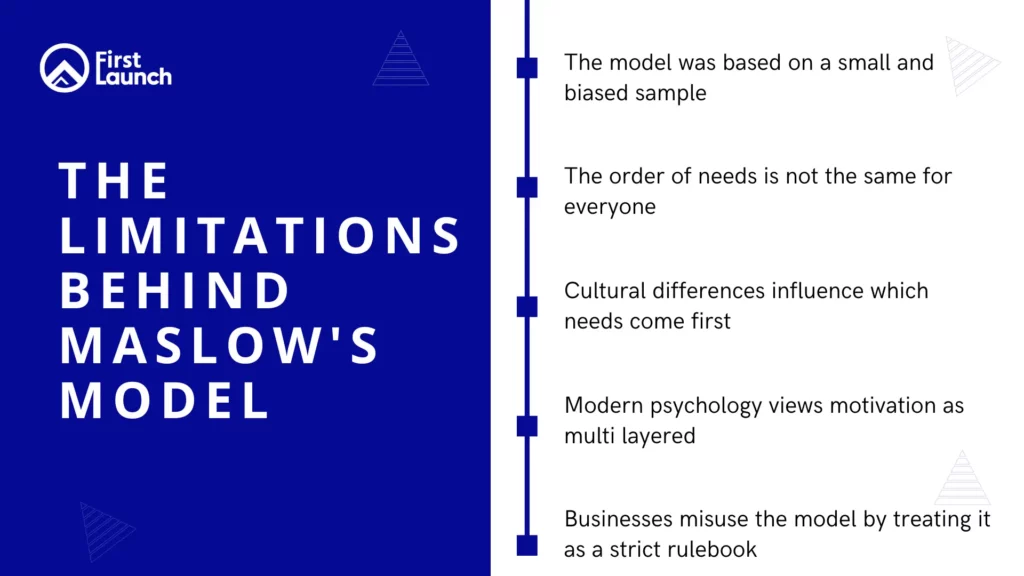
A few major limitations businesses often overlook:
1. The model was based on a small and biased sample
Maslow developed the theory using people he personally considered “self actualised”.
This creates a bias because the study did not include diverse cultures, backgrounds, or socioeconomic situations.
2. The order of needs is not the same for everyone
Some people prioritise belonging before safety.
Some chase achievement even when they lack stability.
Artists, activists, and entrepreneurs often pursue creativity first, regardless of financial comfort.
3. Cultural differences influence which needs come first
In some cultures, community and family outweigh individual achievement.
In others, personal freedom may come before belonging.
Maslow’s order does not always apply globally.
4. Modern psychology views motivation as multi layered
Current research suggests that people often pursue several needs at once.
Someone can seek esteem, belonging, and purpose simultaneously.
5. Businesses misuse the model by treating it as a strict rulebook
When companies assume employees fit one level at a time, they misread their needs and create ineffective policies.
So while the model is an excellent guide, it should never be used as a rigid formula. It works best when used as a lens to understand behaviour, not a prediction tool.
Maslow’s Pyramid in Marketing
Marketing is psychology in action. Every message, design choice, campaign, and product feature taps into one of Maslow’s levels.
For example:
• Physiological needs attract customers looking for basic utility.
• Safety needs attract customers who want reliability and protection.
• Social needs build customer communities and brand belonging.
• Esteem needs create status driven branding.
• Self actualisation positions the brand as a tool for personal growth.
When marketers understand what needs their audience is focused on, their messaging becomes sharper and far more effective.
Why Maslow’s Hierarchy is Important to Marketers
Marketers spend a lot of time analysing behaviour, building campaigns, and crafting messages that resonate. Maslow’s hierarchy gives marketers a clear understanding of what people are looking for when they evaluate a brand.
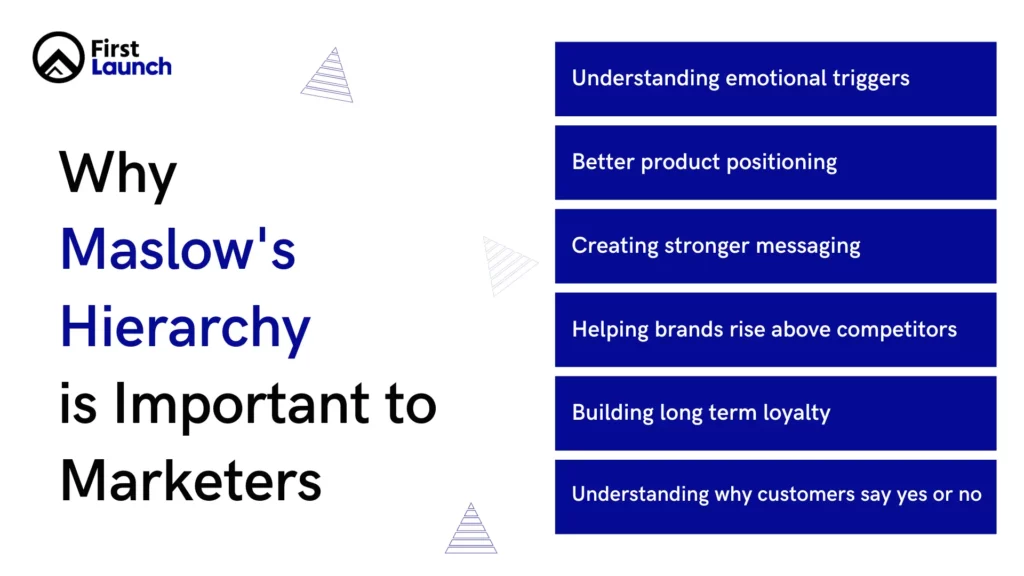
Here is how each need level helps marketers do their job better.
1. Understanding emotional triggers
Every buying decision is linked to a need.
When marketers know the underlying need, they can shape messages that hit the right emotional point.
2. Better product positioning
A brand selling safety should not communicate like a brand selling luxury or creativity.
Positioning becomes sharper when you know which need your product satisfies.
3. Creating stronger messaging
Messages built around needs feel more human and less forced.
Customers connect faster when they see themselves in the message.
4. Helping brands rise above competitors
Most companies promote features, but features rarely move customers emotionally.
When a brand addresses deeper needs such as belonging or esteem, they become memorable.
5. Building long term loyalty
Customers stay loyal when a brand supports their growth, identity, or lifestyle.
This is how brands guide customers to higher levels of the pyramid.
6. Understanding why customers say yes or no
A rejection is usually rooted in an unmet need.
Maybe the customer did not feel safe, confident, understood, or valued.
Once marketers identify which level was missed, they can adjust the strategy instantly.
Marketers who master human needs never struggle with engagement or conversions. They simply understand people at a deeper level.
Why Businesses Still Rely on Maslow’s Pyramid Today
Even with its limitations, Maslow’s hierarchy remains one of the most practical frameworks for understanding workplace and customer behaviour. The reason is simple. Organisations perform better when they understand what people genuinely need, not what they claim to want.
Here is why it still matters:
It helps explain employee engagement
Low engagement is often a sign of unmet needs.
If employees feel unsafe, undervalued, or disconnected, performance naturally collapses.
Maslow helps leaders pinpoint exactly where the breakdown is happening.
It helps design a healthier workplace culture
Culture is not created through posters or meetings.
It grows when the basic psychological needs of employees are consistently met.
It helps reduce turnover
Most resignations have nothing to do with salary.
People leave when they feel unsafe, unappreciated, or disconnected.
Maslow’s hierarchy highlights these hidden emotional triggers.
It helps with leadership development
Leaders who understand human needs communicate better, reduce conflict, and earn trust faster.
Leadership is less about authority and more about meeting the psychological needs of the people you lead.
It helps businesses understand purchasing behaviour
When brands understand the hierarchy of customer needs, they can position their product more effectively.
A brand that misses the need level its audience is in will always struggle with sales.
Maslow may not have designed this model for business, but it has become a strategic tool that helps organisations build systems that people actually respond to.
The Five Levels of Maslow’s Hierarchy Explained for Business
Now let’s break down each level with a business lens.
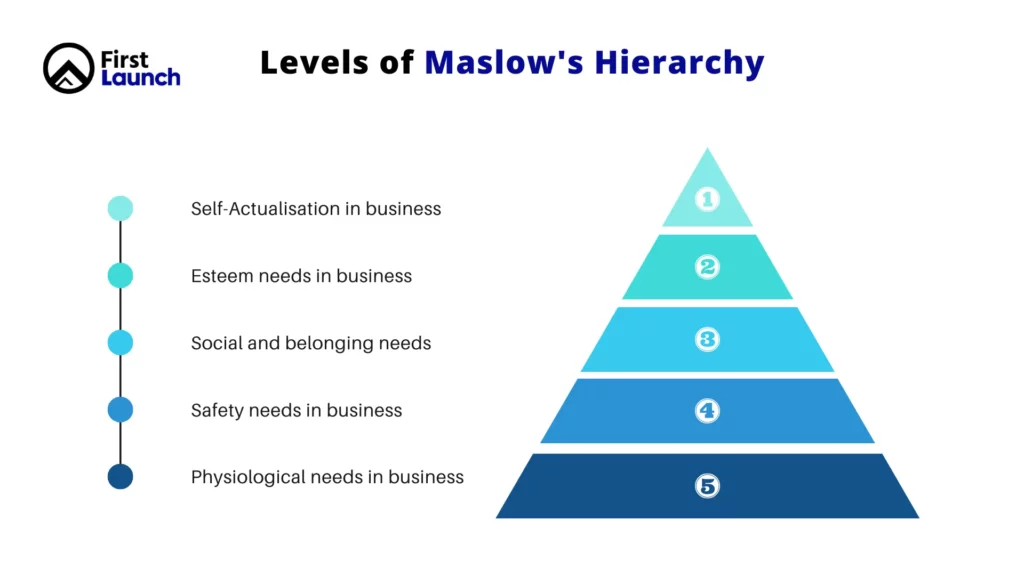
Physiological needs in business
These are the absolute basics. If an employee is exhausted, underpaid, or physically uncomfortable, no amount of motivational speeches will help.
This includes fair salaries, access to breaks, reasonable working hours, good equipment, clean facilities, and a healthy work environment.
From a customer angle, this level relates to the basic function of a product. Does it work? Does it deliver the essentials? If not, customers will not care about branding or storytelling.
Safety needs in business
Safety is not just physical protection. It includes job stability, transparent management, fairness, and predictable company behaviour.
Employees thrive when they trust the organisation. If they fear layoffs, sudden changes, or toxic leadership, they will never feel safe enough to perform at their best.
For customers, safety means reliability. They want brands that feel consistent, trustworthy, and secure.
Social and belonging needs
People want to feel part of something. In business, this comes through strong team cultures, friendships at work, mentorship, and inclusive environments.
Customers also look for belonging. Many brands today build communities, not just products. Think loyal fanbases, online groups, local meetups, and shared identity. Belonging creates emotional attachment.
Esteem needs in business
Employees want to feel valued. Recognition, appreciation, meaningful titles, autonomy, and achievements matter. When organisations treat workers like replaceable parts, esteem drops, and performance follows.
For customers, esteem plays a massive role in brand choice. People buy products that make them feel confident or respected. Prestige brands thrive at this level.
Self actualisation in business
This level is about purpose and fulfilment. Employees want to grow, explore, innovate, and contribute to something meaningful. Businesses that encourage creativity and purpose see stronger engagement and lower burnout.
For customers, self actualisation appears when brands help them express identity, pursue goals, or live a better version of themselves.
Maslow’s Hierarchy in Business Applications
Businesses use Maslow’s hierarchy as a blueprint for designing workplaces, communication styles, leadership behaviour, and even product strategy. Here is how companies apply the pyramid practically.
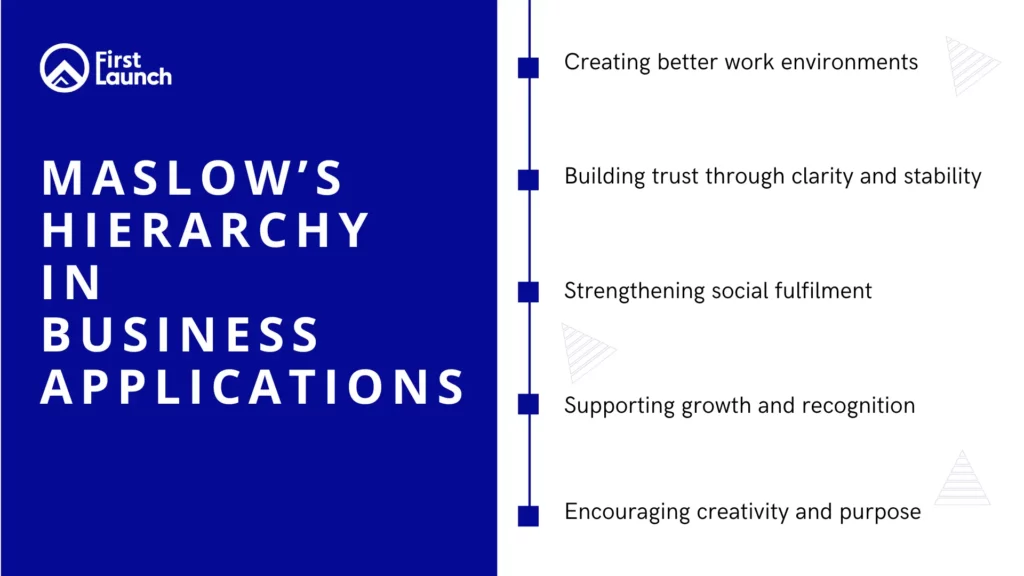
Creating better work environments
When the basics are taken care of, people focus better.
Companies ensure adequate seating, ventilation, lighting, working tools, break areas, and healthy schedules.
These are the bottom of the pyramid but have the highest impact.
Building trust through clarity and stability
Employees need predictable structures.
This includes job clarity, transparent leadership, consistent rules, and fair treatment.
Stability directly influences motivation and loyalty.
Strengthening social fulfilment
A strong culture is never accidental.
Mentorship programmes, cross team collaborations, team activities, and community spaces help people feel connected.
Belonging drives loyalty.
Supporting growth and recognition
Employees stay when they feel seen and respected.
This includes appreciation, fair promotions, autonomy, and opportunities to upskill.
Esteem is a major driver of morale.
Encouraging creativity and purpose
People want to contribute something meaningful.
Businesses that give room for innovation, purpose driven missions, and personal development see stronger long term commitment.
When companies use the hierarchy proactively, they become places where people want to work, not just places where they earn a salary.
A Practical Framework for Businesses and Marketers
Use this simple checklist to apply Maslow’s hierarchy to your organisation.
Employee checklist
• Are basic working conditions comfortable
• Is pay fair and transparent
• Are employees safe physically and psychologically
• Do teams feel connected
• Is recognition consistent
• Are there opportunities for creativity and growth
Customer checklist
• Does the product reliably solve the basic problem
• Does the brand feel trustworthy
• Does the customer feel part of a community
• Does the brand boost customer confidence
• Does the brand help customers express identity or purpose
Conclusion
Maslow’s hierarchy may be an old theory, but its relevance in business has only grown. Businesses succeed when they understand people, not just numbers. Employees perform better when their needs are met. Customers stay loyal when they feel understood and valued.
Behind every decision sits a human being with layered needs. The companies that acknowledge those needs build stronger cultures, better products, and deeper customer relationships.
Maslow’s hierarchy is not a perfect model, but it is a powerful reminder. If you want people to give their best, you must treat them like whole individuals, not resources. The more human your business approach becomes, the more your organisation will thrive.
Frequently Asked Questions
What is Maslow’s hierarchy in business
It is a framework used to understand employee motivation, workplace behaviour, and customer needs.
What is the difference between Maslow’s hierarchy and Maslow’s pyramid
Both refer to the same model. The pyramid is simply the visual representation.
Is Maslow’s theory still relevant in modern workplaces
Yes, because human needs remain the same. The context changes, but motivation patterns stay consistent.
How is Maslow’s pyramid used in marketing
Marketers use it to understand emotional triggers, customer motivations, and the deeper reasons people choose certain brands.

