
The dpdp act (Digital Personal Data Protection Act) marks one of the most significant regulatory shifts in the history of digital marketing in India. As we move closer to 2026, this legislation is no longer just a legal concern. It has become a core marketing responsibility.
From how brands collect leads to how campaigns are tracked, optimized, and scaled, the dpdp act fundamentally changes the way personal data can be used online. For every digital marketing agency in Bangalore, every social media marketing agency in India, and every performance marketing agency in Bangalore, understanding this law is now essential for survival, not just compliance.
At First Launch, a results-driven digital marketing agency in India, we see the dpdp act as more than a restriction, it is a turning point that forces marketers to build trust-first, privacy-led growth systems. Businesses that fail to adapt risk penalties, platform restrictions, and loss of consumer confidence, while those that align early will gain a strong competitive advantage.
This guide breaks down what the dpdp act really means for digital marketers, how it impacts SEO, social media, paid advertising, and analytics, and what practical steps brands and agencies must take today to stay compliant without sacrificing performance.
Quick summary: why the DPDP Act matters for marketers
- The dpdp act raises the bar for informed consent, accountability, and data minimization.
- It gives data principals (users) stronger rights: access, correction, erasure, and withdrawal of consent.
- There are strict breach notification and cross-border transfer rules that affect ad tech, analytics, and martech providers.
These points mean marketing teams must shift from opaque, third-party-data-heavy tactics to privacy-first strategies focused on first-party data and transparent user consent.
Key provisions every marketing team should understand
Data fiduciaries & accountability
Organisations that collect or control personal data are treated as Data Fiduciaries and must document purposes, lawful bases, and security measures.
Rights of data principals
Users can request correction, deletion, or withdrawal of consent. Make self-service flows available and respond within statutory timelines.
Consent rules and purpose limitation
Consent must be informed, specific, and granular. Blanket consent for “marketing and other uses” is no longer sufficient.
Breach notification & penalties
Organizations must notify the regulator and affected users swiftly in case of a breach. Non-compliance can lead to heavy fines and reputational damage.
Cross-border data transfer controls
Transfers are allowed only to jurisdictions or mechanisms approved under the Act, this may force localisation or contractual safeguards.
How the DPDP Act changes daily marketing operations
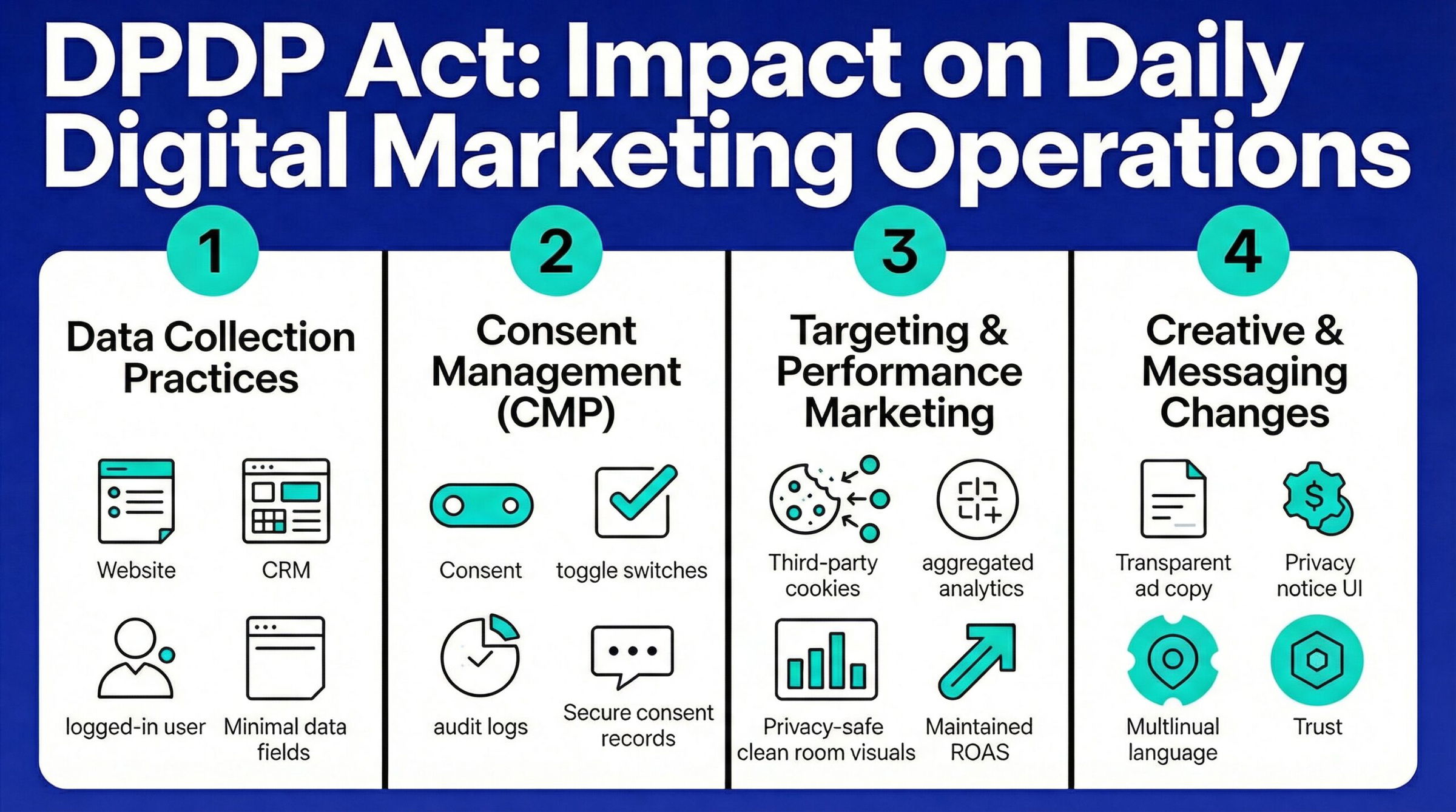
Data collection practices
- Prioritize first-party data (on-site form fills, CRM, logged-in behavior).
- Minimize data fields: collect only what’s strictly necessary for the intended purpose.
Consent management becomes core martech
- Implement a Consent Management Platform (CMP) that supports granular opt-ins and easy withdrawal.
- Store consent records for auditability.
Impact on targeting & performance marketing
- Expect reduced deterministic signals from third-party cookies and ID graphs.
- Embrace probabilistic models, aggregated measurement, and privacy-preserving clean rooms.
This is crucial for performance marketing agencies in Bangalore teams aiming to sustain ROAS without violating dpdp act rules.
Creative & messaging changes
- Be transparent in ad copy and lead forms about data use.
- Localize privacy notices (including regional languages) — good UX + compliance = trust.
Practical 8-point DPDP compliance checklist for marketers

- Map data flows: inventory where personal data comes from, how it’s used, and where it goes.
- Minimize data fields: only ask for what’s needed.
- Install a CMP: capture granular consent and maintain consent logs.
- Update privacy notices: clear, short, and local-language options.
- Build self-service rights: mechanisms for access, correction, erasure, and withdrawal.
- Secure data: encryption, role-based access, and vendor assessments.
- Review third parties: ensure tag vendors, analytics, and ad platforms are DPDP-friendly.
- Train teams: product, marketing, and sales should know consent procedures and escalation paths.
Specific implications for agencies (SEO, social, performance)
Social media marketing agency in Bangalore or social media marketing agency in India
- Social campaigns must use explicit consent for data capture (lead ads) and provide clear opt-outs.
- Avoid hidden profiling; ensure any pixel or tag is activated only with user consent.
Performance marketing agency in Bangalore
- Shift measurement to aggregated conversion modelling and server-side tracking where legal.
- Use privacy-preserving attribution and invest in first-party analytics to protect campaign performance.
Digital marketing agency in India teams working with global clients
- Re-evaluate cross-border processing and consider local storage or contractual safeguards.
- Advise clients on updating contracts and DPA clauses with vendors.
E-commerce & service brands: extra considerations
E-commerce and telco sectors handle large volumes of personal data: identity, payment and transaction history. Follow stricter retention policies, verifiable consent for transactional marketing, and stronger security controls to avoid fines and loss of customer trust.
Common misconceptions & practical clarifications
- “Consent alone solves everything.” – Consent is central, but accountability, purpose limitation, and security are equally critical.
- “DPDP = GDPR copy.” – There are overlaps, but DPDP has India-specific rules (e.g., different transfer approaches).
- “We can keep all historical marketing data.” – No. Retain only what’s necessary and justify older datasets if kept.
Action plan: what First Launch will do for clients
- Conduct a DPDP readiness audit: data map, risk areas, and CMP gap analysis.
- Implement or integrate a CMP and consent-aware tag manager.
- Rebuild tracking to favor server-side and first-party approaches.
- Update privacy UX: clear notices, microcopy, and withdrawal flows.
- Train marketing and sales teams on dpdp act-compliant campaign creation.
- Run pilot privacy-first performance tests to benchmark results before full rollout.
If you want hands-on help, First Launch, a performance-focused digital marketing agency in Bangalore and digital marketing agency in India, can lead compliance-first migrations while protecting campaign outcomes.
Conclusion: turn regulation into advantage
The dpdp act is a change agent. Firms that adopt transparent, user-first data practices will earn trust and gain competitive differentiation. For marketers, the shift from opaque targeting to privacy-first personalization is a chance to build long-term customer relationships that outperform short-term, invasive tactics.
Frequently Asked Questions
1. What is the DPDP Act and why should a digital marketing agency in Bangalore care?
The DPDP Act is India’s Digital Personal Data Protection Act (effective 2026). It defines consent, data principal rights, breach notification, and transfer rules. Agencies in Bangalore must adapt tracking, consent, and data flows to avoid fines and protect campaign integrity.
2. How does the DPDP Act affect social media marketing agencies in India?
Social media agencies must ensure all data capture (lead forms, pixels) is consent-driven, provide opt-outs, and avoid hidden profiling. This affects creative, targeting, and analytics setups.
3. Can a performance marketing agency in Bangalore still run targeted ads under the DPDP Act?
Yes, but targeting should rely more on first-party signals, aggregated measurement, and privacy-preserving methods rather than unrestricted third-party profiling.
4. What immediate steps should a digital marketing agency in India take to comply with the DPDP Act?
Map data flows, deploy a CMP, minimize collected data, update privacy notices, and implement self-service rights for users.
5. Will DPDP force businesses to store data only in India?
The Act restricts cross-border transfers to approved mechanisms. Some firms may choose local storage; others can use approved safeguards. Legal review and vendor updates are necessary.
6. How does consent under the DPDP Act differ from past practices?
Consent must be informed, specific, and revocable. Blanket or pre-ticked consent is not valid. Consent records must be retained for audit.
7. What penalties can agencies face for non-compliance?
The Act prescribes significant fines for mishandling data or failing to prevent breaches. Reputational harm and business interruptions are also likely.
8. How should e-commerce marketers in Bangalore change lead forms and CRM workflows?
Collect only essential fields, add purpose-specific consent checkboxes, and provide clear links to privacy settings and deletion requests.
9. Is a consent management platform (CMP) necessary for compliance?
While not always mandatory, a CMP is the most practical way to record, manage, and demonstrate granular consent across digital touchpoints.
10. How can First Launch help my business comply while keeping marketing performance?
First Launch combines legal-aware implementation (CMP, tag governance) with privacy-first measurement (first-party analytics, server-side tracking) so you retain performance while meeting dpdp act obligations.

