Digital marketing looks different than it did even two years ago. You’re probably seeing this shift in your own work. AI isn’t just some tech trend anymore – it’s becoming the main tool that runs modern marketing.
Here’s something that caught your attention: the AI marketing market was worth $12 billion in 2020. By 2028, experts think it’ll hit $107 billion. That’s not slow growth. That’s a massive shift.
The question isn’t whether you should use AI. It’s how fast you can learn to work with it.
The Two Main AI Tools That Run Marketing Today
Let’s break down what actually powers AI marketing. You’ve heard “AI” thrown around everywhere, but what does it really mean?
Machine Learning
Think of Machine Learning (ML) as a really smart system that learns from data. It spots patterns you’d never see on your own.
Here’s where you see ML working:
- Smart Ad Targeting – Facebook and Google use ML to watch how people behave online. Then they show your ads to the right people at the right time.
- Lead Scoring – ML looks at your customer data and tells you which leads will probably buy. Your team can focus on the hot leads instead of cold calling everyone.
- Personal Picks – Netflix and Spotify use ML to suggest what you might like. That’s why their users stick around.
Natural Language Processing
Natural Language Processing (NLP) helps computers read and write like humans. It’s the tech that lets AI understand what people actually mean when they type or talk.
You see NLP in action here:
- Chatbots – They answer customer questions 24/7. No more waiting until Monday morning for support.
- Modern Search – Google doesn’t just match keywords anymore. It tries to figure out what you’re really asking for.
- Feeling Checker – AI reads through thousands of reviews and social posts to tell you if people love or hate your brand.
The thing is, ML and NLP work better together. NLP reads what customers write in reviews. Then ML takes that info and finds patterns. It’s a loop that keeps getting smarter.
Five Stages: Where Your Business Fits
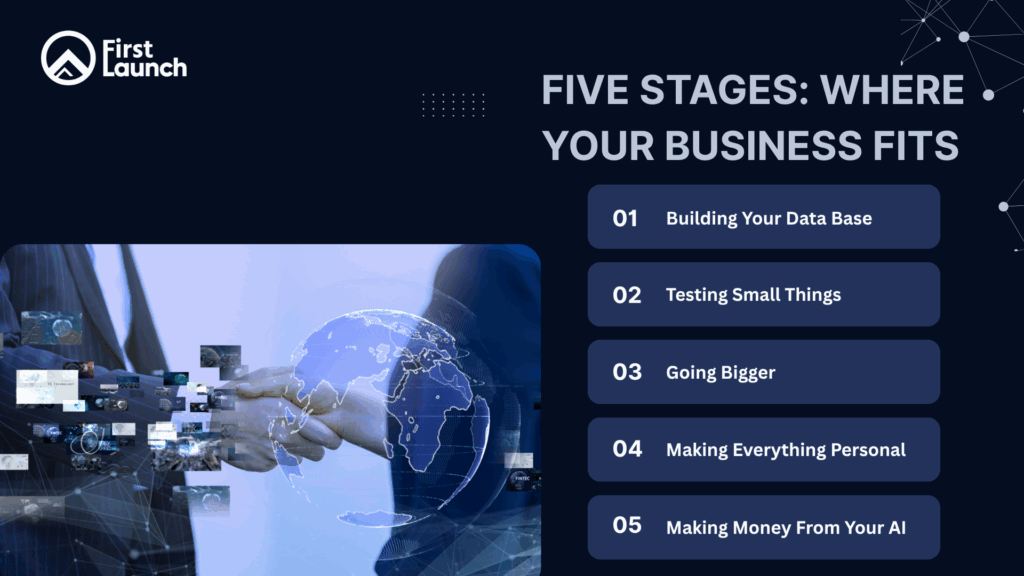
You’re probably wondering where you stand with AI. Most companies fall into one of five stages. Let’s figure out which one describes you.
Stage 1: Building Your Data Base
This is where everyone starts. You need to collect good data about your customers – stuff you gather directly from them, not from third parties.
Real Example: Coca-Cola put out those Freestyle drink machines. Yeah, the ones where you pick your own flavors. Those machines collect data on what people like to drink. Smart, right?
Stage 2: Testing Small Things
Once you have data, you start testing. Pick one thing to improve with AI. Keep it small.
Real Example: Starbucks spent ten years (seriously, ten years) working on their rewards program. They went from sending 30 generic emails per week to sending 400,000 custom emails. Each one is different based on what that customer likes.
Stage 3: Going Bigger
Now you take what worked in your tests and spread it across your business. You’re using AI in multiple places, not just one.
Real Example: Thread, a fashion brand, mixed AI picks with human stylists. The AI suggests clothes, then real people add their touch. It’s both smart and personal.
Stage 4: Making Everything Personal
This is the big leagues. You’re using AI to customize every single thing a customer sees or does with your brand.
Real Example: Disney’s MagicBand tracks where you go in their parks. It helps them predict crowds, move staff around, and suggest rides you might like. The whole park becomes personal.
Stage 5: Making Money From Your AI
The final stage is when your AI tech becomes so good, you can sell it to others. Your marketing becomes a profit maker, not just a cost.
Here’s a quick view of all five stages:
| Stage | Main Goal | What You Do | Company Example |
| Building Base | Get first-party data | Set up data collection | Coca-Cola Freestyle |
| Testing | Make things better for customers | Run small AI tests | Starbucks Rewards |
| Going Bigger | Connect everything | Mix AI with human input | Thread Stylists |
| Making Personal | Custom every touch point | Build your own AI systems | Disney MagicBand |
| Making Money | Create new income | Sell your AI tech | (Still emerging) |
You might be at Stage 1 looking at Stage 4 thinking “that’s years away.” You’re right. But you have to start somewhere.
How AI Actually Changes Your Marketing Work
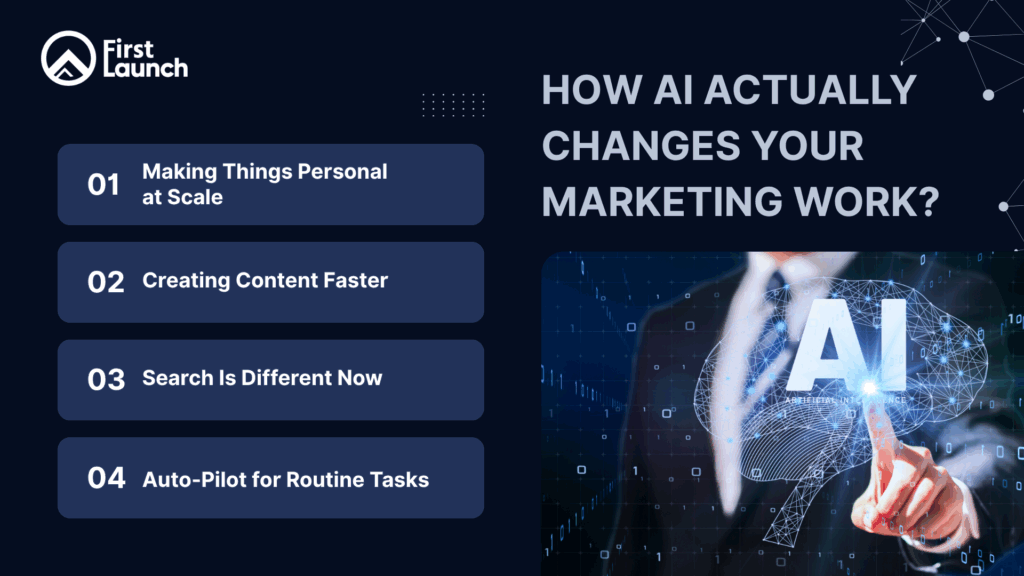
Let’s get into the real stuff. How does AI change what you do every day?
Making Things Personal at Scale
Remember when personal marketing meant using someone’s first name in an email? That’s old news. AI can now customize everything – the images, the words, the offers, even the timing.
The Numbers: Personal emails get opened 29% more often. They get clicked 41% more. That’s not a small difference.
The Big Save: Netflix saves about $1 billion per year just from their recommendation system. Why? Because people don’t cancel when they keep finding shows they like.
Creating Content Faster
AI isn’t replacing writers. But it’s making them way more productive. You’re still the creative brain. AI just handles the boring parts.
What People Are Doing:
- 45% of marketers use AI to come up with content ideas
- 51% use it to write first drafts
- 93% say they can create content much faster now
Making Images: Tools like Midjourney and DALL-E 3 can create visuals from text. You type “a modern office with plants and natural light” and boom – you get an image. Takes seconds instead of hiring a photographer.
Search Is Different Now
SEO used to be about stuffing keywords into your content. Now it’s about understanding what people really want when they search.
What Changed:
- AI tools look at search data to find the real questions behind searches
- They handle the boring tasks like fixing your meta tags
- They watch how people use your site and suggest ways to make it better
Auto-Pilot for Routine Tasks
AI handles the repetitive stuff so you can think about strategy.
Email: HubSpot and similar tools send custom email series based on what people do. Someone leaves items in their cart? Auto-email goes out.
Social Media: AI figures out when your audience is most active. It schedules posts for those times.
Customer Service: Chatbots handle basic questions all day and night. Your human team deals with the complex stuff.
Here’s what you’re seeing happen: AI does the tactical work. Your job shifts to being the strategic thinker who tells the AI what to do.
The Problems You Need to Watch Out For
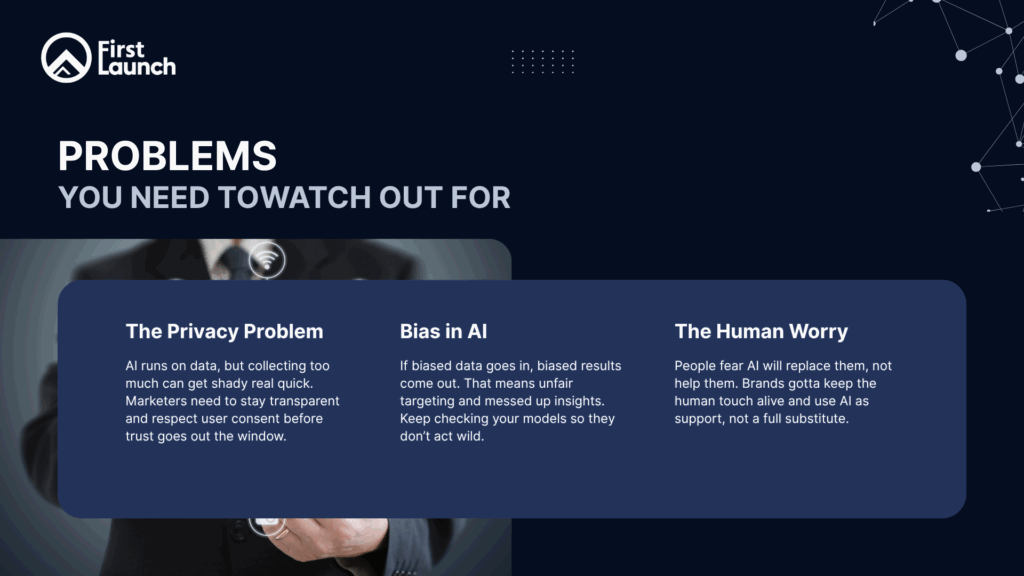
Let’s be upfront about something – AI isn’t perfect. It comes with real risks.
The Privacy Problem
AI needs data to work well. But people are freaked out about how their data gets used. 81% of people worry their data will be used in ways they wouldn’t like.
- The Rules: GDPR and CCPA are complex laws about data privacy. The “right to be forgotten” is especially tricky – how do you delete data that’s already trained into an AI model?
- The Risk: Mess this up and you face legal penalties. Plus, your reputation takes a hit.
Bias in AI
AI learns from the data you feed it. If that data has bias in it, the AI learns the bias too. Then it makes biased decisions.
Real Cases:
- AI showed ads for arrest records more often when people searched Black-sounding names
- Amazon built a hiring AI that penalized resumes with the word “women’s” in them. They had to scrap the whole thing.
The Fix: You need diverse training data. Ask platforms to be transparent about their AI. Consider other options like contextual targeting that don’t rely on personal data.
The Human Worry
About 60% of marketing folks worry AI will take their jobs. That fear is real, even if it’s not quite accurate.
What Actually Happens: Jobs shift toward strategy instead of execution. But if you rely too much on AI, your content becomes bland. It loses the human touch that makes brands feel real.
The Training Gap: 88% of digital marketers use AI. But 70% say their company gave them zero training on it. That’s a problem. People misuse tools they don’t understand.
Your Action Plan: What to Do This Week
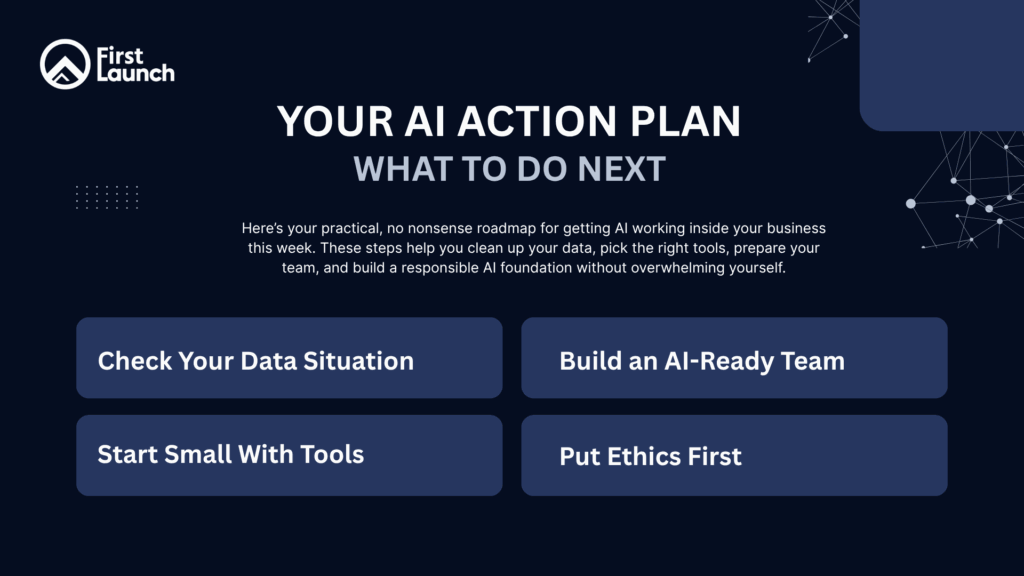
Alright, enough theory. Here’s what you actually do.
1. Check Your Data Situation
AI only works if you have good data. Look at what data you’re collecting right now. Is it accurate? Is it organized? Do you have rules about who can access it?
2. Start Small With Tools
Don’t try to overhaul everything at once. Pick one process that’s ripe for AI. Maybe it’s scheduling emails. Maybe it’s analyzing data. Start there, measure the results, then expand.
Here are tools you might want to check out:
Project Work:
- Wrike: Helps manage workflows with AI
- Zapier: Connects your tools and automates tasks
Content and SEO:
- MarketMuse: Helps plan content strategy
- Surfer SEO: Guides SEO-friendly writing
Writing:
- Jasper AI: Generates marketing copy
- Writer: Creates blog posts and content
Customer Service:
- Tidio: AI chatbots for support
- Chatfuel: Automated customer conversations
Lead and Customer Management:
- Marketo: Lead management with AI
- HubSpot: Email automation and CRM
Analysis:
- GWI Spark: Market research
- BuzzSumo: Trend analysis
3. Build an AI-Ready Team
Technology alone won’t save you. Your team needs to understand this stuff.
Training Matters: Teach your team how to use AI tools. Cover data ethics. Show them how to write good prompts (that’s becoming a key skill).
Test Often: Make it safe to try new things. Run small pilots. Learn what works without betting the farm.
4. Put Ethics First
Set up rules for how you use AI. Define how you’ll manage AI projects. How will you check tools before using them? How will you handle data?
Check your AI systems regularly for bias. Make sure they’re secure.
Common Questions About AI in Marketing
What is AI marketing and how does it work?
AI in marketing uses machine learning and natural language processing to automate tasks, analyze data, and personalize customer experiences. It works by learning from patterns in your data to make predictions and decisions.
How much does AI marketing cost?
Costs vary widely. Basic tools like chatbots start at $50-$200/month. Mid-level platforms run $500-$2,000/month. Enterprise solutions can cost $10,000+ monthly. Start small and scale up as you see results.
Will AI replace marketing jobs?
No, but it will change them. AI handles repetitive tasks while humans focus on strategy, creativity, and relationship building. The jobs that adapt will combine human insight with AI capabilities.
What data do I need for AI marketing?
You need first-party data – info collected directly from your customers. This includes website behavior, email engagement, purchase history, and customer service interactions. Quality matters more than quantity.
How do I choose the right AI marketing tools?
Start by identifying your biggest time drain or weakest process. Look for tools that solve that specific problem. Check if they integrate with your current systems. Read real user reviews, not just marketing materials.
Can small businesses use AI marketing?
Yes. Many AI tools are now affordable and easy to use. Start with free or low-cost options like AI chatbots, email automation, or social media scheduling. You don’t need a huge budget to begin.
How long does it take to see AI marketing results?
Simple automation tools show results in weeks. Personalization and predictive systems take 3-6 months to gather enough data and optimize. Transformation-level AI can take 1-2 years to fully implement.
Is AI marketing safe and ethical?
It can be, but it requires active management. You need clear data privacy policies, regular bias audits, and ethical guidelines for AI use. Transparency with customers about AI usage builds trust.
What skills do marketers need for AI?
Data literacy, prompt engineering, analytical thinking, and ethical decision-making. You don’t need to code, but you should understand how AI tools work and how to interpret their outputs.
How do I measure AI marketing ROI?
Track specific metrics tied to your AI tools. For chatbots, measure response time and customer satisfaction. For email AI, track open rates and conversions. Compare performance before and after AI implementation.
The Future: Human Plus Machine
AI is rewriting how digital marketing works. But here’s what you need to know – the future isn’t humans versus machines.
The best marketers will be what some call “Centaur Marketers.” Part human strategy, part machine power. You bring creative thinking, empathy, the understanding of what makes people tick. AI brings speed, scale, and the ability to process massive amounts of data.
The goal isn’t to replace human creativity. It’s to boost it with AI’s capabilities.
Companies that win will be the ones who blend human wisdom with AI tools. They’ll create marketing that’s more efficient, more effective, and actually more human because it’s more relevant to each person.
You’re still working through this, like everyone else. AI is new enough that we’re all learning as we go. Part of you might think this is overhyped. Another part sees the real potential. Both views are probably right.
Ready to start? The shift is happening whether you jump in or not. At First Launch – Digital Marketing Agency in Bangalore, India, we help businesses figure out where they are on this journey and what to do next. Reach out if you want to talk through your specific situation.
Blog written by Divakar Thiyagarajan, First Launch

