
Looking to increase sales in your online store? E-commerce SEO helps shop owners and marketers get more organic traffic from search engines. This guide covers essential strategies to improve your store’s rankings and attract customers ready to buy.
We’ll explore how to optimize product pages with compelling descriptions and images that both shoppers and search engines love. You’ll also learn about technical SEO fixes that prevent common e-commerce website issues that hurt your rankings.
Understanding E-Commerce SEO Fundamentals
Why Traditional SEO Tactics Fall Short for Online Stores?
Running an online store? Those standard SEO playbooks won’t cut it. We’ve seen countless store owners apply blog-focused SEO strategies to their product pages and wonder why they’re not ranking.
Here’s the truth: selling products requires a completely different approach than selling information. When someone searches “how to fix a leaky faucet,” they want a helpful guide. But when they search “buy waterproof bathroom faucet,” they’re ready to pull out their credit card.
Traditional SEO tactics focus heavily on text-heavy content, which works great for blogs but can actually hurt conversion rates on product pages. We’ve found that overloading product pages with keyword-stuffed paragraphs confuses shoppers and distracts from what matters, making the sale.
Key Differences Between Content Sites and E-Commerce Platforms
Content sites and online stores serve fundamentally different purposes, and we need to approach them differently:
| Content Sites | E-Commerce Platforms |
|---|---|
| Goal: Information delivery | Goal: Product sales |
| Success metric: Time on page | Success metric: Conversion rate |
| Content focus: In-depth articles | Content focus: Product features/benefits |
| Navigation: Topic-based | Navigation: Category-based |
| CTAs: Read more, subscribe | CTAs: Add to cart, buy now |
The biggest mistake we see? Store owners are trying to rank for informational keywords instead of transactional ones. Your online store should focus on capturing shoppers who are ready to buy, not just anyone looking for information.
Essential SEO Metrics Every Store Owner Should Track
Forget vanity metrics. We track these e-commerce specific KPIs that actually impact our bottom line:
- Product Page Conversion Rate – This tells us if our SEO is bringing the right kind of traffic. Low conversion rates with high traffic? You’re attracting the wrong visitors.
- Category Page Performance – Often overlooked, but category pages can be SEO powerhouses when optimised correctly.
- Revenue Per Search Term – Keywords are not all created with equal significance. We focus on the ones that actually generate sales, not just traffic.
- Organic Product Views – This shows us which products are getting natural visibility in search results.
- Indexed Product Pages – If Google isn’t indexing all your products, you’re missing out on potential sales.
Unlike content sites where traffic and rankings are paramount, our e-commerce SEO success hinges on whether visitors become customers. Pretty simple, right?
Keyword Research for E-Commerce
1. Why Keyword Research is the Foundation of Your SEO Strategy
If e-commerce SEO were a building, keyword research would be the blueprint. Without it, you risk creating pages that nobody searches for or targeting terms so broad that you get lost among thousands of competitors. For an online store, the goal is not just to attract visitors, it is to attract visitors who are ready to buy.
Effective keyword research identifies the exact phrases your target audience uses when searching for products like yours. It connects the difference between what you believe users are searching for and what they truly enter into Google. This step ensures that your optimisation efforts translate directly into revenue rather than just page views.
2. Understanding the Types of Keywords in E-Commerce
Not all keywords are equal. Within e-commerce, they are commonly grouped into three key categories:
- Transactional keywords: These keywords point to users who are ready to complete a transaction. Examples include “buy wireless headphones online” or “order organic coffee beans India”. These keywords should drive the content strategy for product and category pages.
- Informational keywords: These search phrases are used by customers seeking information before completing a purchase. Examples include “best headphones for gaming” or “how to choose organic coffee”. These work well for blog content designed to lead customers toward your products.
- Navigational keywords: These include queries aimed at a specific retailer or brand, like “Nike running shoes official store” or “Starbucks coffee beans online.” These are often brand-protection terms and should be monitored closely.
Balancing these keyword types ensures you capture customers at different stages of their buying journey.
3. The Power of Long-Tail Keywords
Short, general keywords such as “headphones” often lack specificity and face high competition. Long-tail keywords, which are longer and more specific phrases, tend to convert better because they match precise customer intent.
For example:
- Broad keyword: “running shoes” (high competition, low intent clarity)
- Long-tail keyword: “buy lightweight men’s running shoes size 9 India” (low competition, clear intent, higher conversion rate)
Long-tail keywords also open opportunities to target niche segments of your audience without competing directly with massive retailers who dominate broad terms.
4. Mapping Keywords to the Buyer Journey
Keyword research should not stop at finding terms with good search volume. You also need to map them to the customer’s decision-making process:
- Awareness stage: The user realises they have a need. Example: “how to improve home audio quality”.
- Consideration stage: They are comparing solutions. Example: “Bluetooth speakers vs soundbars for small rooms”.
- Purchase stage: They are ready to buy. Example: “buy Bluetooth soundbar online under 5000”.
By creating content for each stage, you guide potential customers from curiosity to purchase without losing them to competitors in between.
5. Practical Steps for Finding E-Commerce Keywords
Here is a straightforward process to follow:
- List your product categories and individual products.
- Use a keyword research tool to find transactional and long-tail variations for each.
- Analyse search intent to ensure the keyword matches your page type.
- Check the competition and identify where you have a realistic chance to rank.
- Group related keywords so that each page targets a focused set rather than trying to rank for everything.
When this research is done right, every page of your store has a clear purpose and a measurable opportunity to bring in qualified traffic.
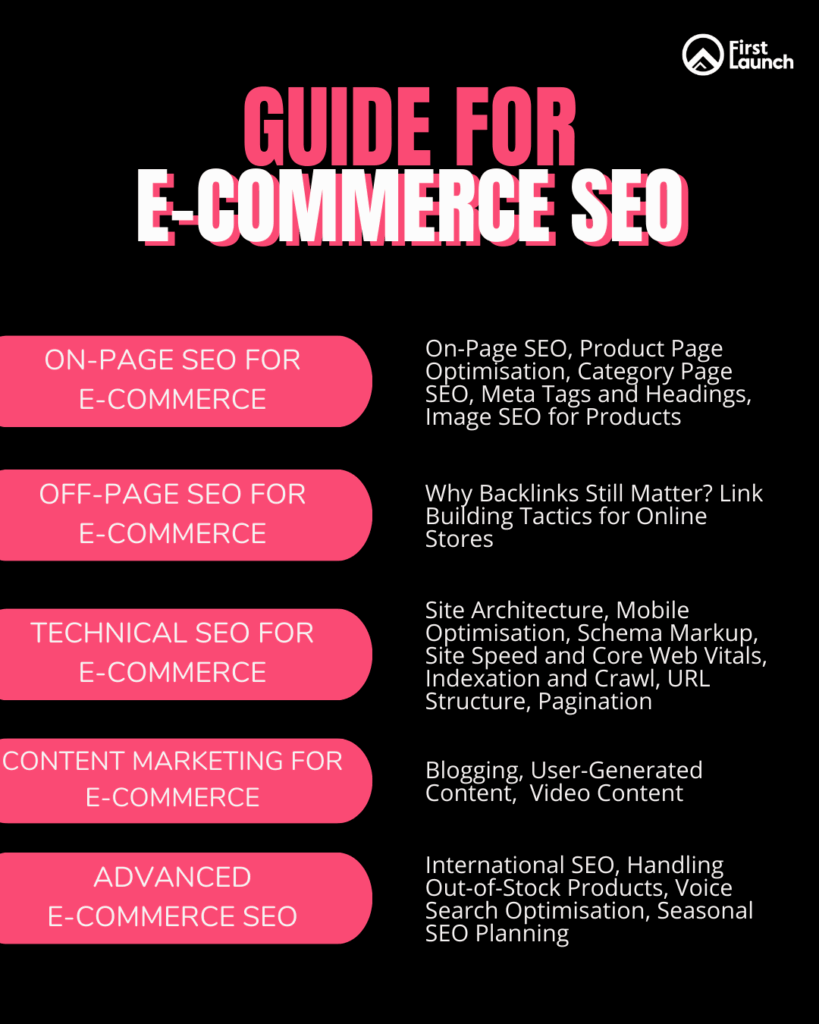
On-Page SEO for E-Commerce Websites
1. Why On-Page SEO Matters for E-Commerce
On-page SEO is the part of your strategy that customers can see and interact with directly. It is where you fine-tune each page to make it relevant, clear, and appealing to both search engines and human visitors. For e-commerce, this means product pages, category pages, and even search results within your own store should be optimised to answer the shopper’s needs instantly.
Well-optimised pages have two jobs. First, they must tell search engines exactly what the page is about. Second, they must convince the visitor to take the next step, whether that is adding a product to the cart or clicking through to related items.
2. Product Page Optimisation
Think of a product page as the digital equivalent of a sales pitch. It should provide enough detail to answer questions, remove doubts, and make purchasing feel like the natural choice.
Key elements to optimise:
Product titles: Product titles can make or break e-commerce SEO. Many online stores lose potential visibility and sales by using generic, uninspiring titles. Strong titles balance keyword relevance with readability, giving both search engines and shoppers exactly what they need.
Here are proven best practices:
- Place the primary product name first
- Add important specifications such as size, colour, or material
- Mention the brand name
- Keep titles under 60 characters whenever possible
For example:
- A weak title: “Blue Shirt”
- A strong title: “Men’s Cotton Oxford Button-Down Shirt Navy Blue ComfortWear”
The difference is clear. The stronger title provides search engines with context and gives customers the precise details they are looking for.
Product descriptions: Product descriptions should do more than list features. They act as mini sales pitches that also carry SEO value. The strongest descriptions tend to follow a clear structure:
- Open with a benefit-focused statement
- Add 2–3 short paragraphs highlighting features and benefits
- Integrate semantic keywords naturally throughout
- End with a compelling call to action
Rather than keyword cramming, impactful descriptions focus on providing customer-relevant answers. What problem does this product solve? How does it feel in use? What makes it stand out from alternatives?
When descriptions highlight benefits in a natural, conversational way while addressing common search queries, rankings improve organically. Bullet points can also be highly effective, not just for readability but because search engines often favour them in featured snippets.
Customer reviews: Reviews contribute fresh, keyword-rich content, making them one of the most effective yet underrated SEO tools. Reviews continuously add fresh, keyword-rich content to product pages without requiring constant content updates.
Smart ways to harness reviews for SEO include:
- Implementing structured data markup to make star ratings appear in search results
- Highlighting selected reviews that contain valuable keywords
- Asking specific questions in review requests to encourage meaningful responses
- Responding to reviews, which adds even more unique content to the page
The real advantage of reviews is that they capture the exact language customers use when searching. This not only enriches product pages but also provides insights into the keywords and phrases that matter most to your audience.
Specifications and features: Use bullet points for quick scanning, but include context in sentences for SEO value.
Pricing and availability: Make this prominent and unambiguous. Hidden or unclear pricing can kill conversions.
Calls to action: Make “Add to Cart” or “Buy Now” buttons highly visible and easy to tap on mobile devices.
3. Category Page SEO
Category pages are often underestimated in e-commerce SEO. They can attract a broad audience searching for a type of product rather than a specific one.
Best practices include:
- Create a clean H1 heading that directly features the primary category keyword.
- Add a brief introductory paragraph above the product grid to highlight the range and encourage browsing.
- Place internal links that guide users toward popular products and connected subcategories.
- Ensure filters and sorting options are user-friendly and do not create endless duplicate URLs for the same content.
4. Meta Tags and Headings
Meta titles and descriptions are the snippets that appear in search results for potential customers. They should be both keyword-focused and click-worthy.
- Meta titles: Keep them under 60 characters and place the most important keywords near the start.
- Meta descriptions: Summarise the page in under 155 characters, focusing on benefits rather than features.
- Heading tags (H1, H2, H3): Follow a logical hierarchy so both readers and search engines can follow the content structure easily.
5. Image SEO for Products
Images are often the deciding factor in whether a shopper clicks “buy” or bounces. But poorly optimised images can slow a site, hurt conversions, and drag down rankings. The most effective optimisation practices include:
- Compressing product images to reduce file size (under 100KB is a good benchmark) without sacrificing quality
- Using descriptive filenames instead of generic labels like IMG_2957.jpg. For example: mens-oxford-navy-button-down-front.jpg
- Adding alt text that clearly explains the image while seamlessly incorporating relevant keywords
- Implementing lazy loading so the page loads quickly without waiting for every image to render
Fixing image-related issues can deliver speed improvements of 40 percent or more, and since Google factors page speed into rankings, the SEO benefits are direct. For product galleries, multiple optimised images showing different angles and use cases not only improve user experience but also create more opportunities to appear in Google Images and attract targeted traffic.
Off-Page SEO for E-Commerce
1. Why Backlinks Still Matter
Backlinks remain one of the strongest ranking factors. They act as votes of confidence from other sites, signalling to search engines that your store is credible and relevant.
2. Link Building Tactics for Online Stores
- Collaborate with bloggers or influencers in your niche.
- Create resources worth linking to, such as detailed buying guides or industry reports.
- Reach out to relevant publications for product features or expert commentary.
Technical SEO for E-Commerce
1. Site Architecture That Boosts Crawlability
We’ve seen it happen too many times. E-commerce sites with amazing products but terrible architecture that search engines can’t navigate. The truth? A well-organized website structure ensures search engines can crawl and index your pages more effectively.
A flat site architecture works wonders for e-commerce. We keep it simple: homepage → category pages → product pages, with no page more than 3 clicks from the homepage. This isn’t just good for Google it helps real shoppers find what they need faster.
Internal linking is a powerful weapon. Linking related products, cross-sell between categories, and make sure popular pages pass link equity to newer or less-visited sections.
For larger stores, faceted navigation should be implemented in a way that avoids creating duplicate content issues. Strategic use of canonical tags and robots.txt directives ensures search engines know exactly which versions of pages to index.
2. Mobile Optimisation Strategies for Higher Conversions
Mobile shopping is not the future, it is already the present. Over 60% of e-commerce traffic now comes from mobile devices, yet conversion rates still lag behind desktops.
To close this gap, e-commerce sites should focus on:
- Touch-friendly navigation with larger buttons and simplified menus
- Thumb-zone optimisation for key action buttons
- Responsive images that maintain sharp quality while ensuring quick performance
- Single-column layouts that eliminate horizontal scrolling
- Streamlined checkout processes with minimal form fields
Page speed becomes even more critical on mobile. We compress images, leverage browser caching, and implement lazy loading to ensure pages load in under 3 seconds because every additional second costs you approximately 7% in conversions.
3. Schema Markup Implementation for Rich Snippets
Schema markup functions as a structured guide, making it easier for search engines to read your product information. When implemented correctly, it transforms how your listings appear in search results.
For e-commerce sites, the most valuable schema types include:
- Product schema (price, availability, reviews)
- BreadcrumbList schema (showing category hierarchy)
- Organization schema (company info and contact details)
- Review schema (star ratings and testimonials)
The payoff? Rich snippets that catch the eye, provide key info before clicking, and dramatically improve CTR.
Before going live, it is crucial to validate schema with Google’s Structured Data Testing Tool. Common mistakes to avoid include incomplete product data, missing required fields, and improper nesting of schema types.
4. Site Speed and Core Web Vitals
Slow sites frustrate users and hurt rankings. Improve speed by:
- Compressing images.
- Using a content delivery network (CDN).
- Minimising JavaScript and CSS files.
- Enabling browser caching.
Core Web Vitals, such as loading performance, interactivity, and visual stability, should be monitored and improved regularly.
5. Indexation and Crawl Budget
When search engines focus on duplicate pages or irrelevant URLs, essential product listings could be overlooked. Use robots.txt, canonical tags, and “noindex” directives to control what gets indexed. Manage faceted navigation carefully to avoid creating thousands of near-duplicate URLs from filters.
6. URL Structure Best Practices
URLs might feel like small details, but they carry more weight in e-commerce SEO than most people realise. A clean, logical URL helps search engines understand a page while giving users confidence in where they’re clicking. The most effective practices include:
- Keeping URLs short, descriptive, and easy to scan
- Placing primary keywords closer to the beginning
- Using hyphens to separate words instead of underscores
- Avoiding unnecessary parameters, especially on main category or product pages
- Building logical hierarchies that reflect the site’s structure
A strong example would be: yourdomain.com/category/subcategory/product-name
This structure not only communicates importance to search engines but also ensures shoppers immediately grasp the page’s topic. Consistency across all URL patterns adds another layer of trust, making your site more predictable and crawlable.
7. Addressing Pagination and Filtering Challenges
Pagination and filtering complexities are almost unavoidable in large-scale e-commerce sites. If not handled correctly, these can lead to duplicate content problems, wasted crawl budgets, and diluted SEO signals.
For pagination, the goal is to show search engines that a sequence of product pages belongs together rather than being treated as separate, competing content. The most reliable method is using rel=”next” and rel=”prev” tags, which establish that relationship clearly.
Filtering adds another layer of complexity. Shoppers need to filter by size, colour, price, and other attributes, but search engines don’t need to index every possible filter combination. To manage this effectively, strong practices include:
- Adding noindex tags to filtered results
- Adding canonical tags that signal which main category pages should be treated as the preferred version.
- Implementing AJAX-based filtering that updates results without creating new crawlable URLs
- Building optimised landing pages only for high-value filter combinations that have strong search demand
The goal is balance. Shoppers get a seamless, customisable browsing experience, while search engines receive a clean, logical structure without being overwhelmed by endless duplicate variations.
Content Marketing for E-Commerce SEO
1. Blogging for Product Discovery
A blog should be more than filler content it can act as a powerful SEO engine that drives qualified traffic to product pages. The most effective approach is building content clusters around core product categories. Each post targets specific long-tail keywords that reflect real customer queries and intent.
For instance, if the store sells coffee machines, blog content could include:
- How to clean and maintain an espresso machine
- Single-origin coffee beans versus blended varieties
- Morning coffee rituals that boost productivity
When written naturally, these posts educate readers while weaving in subtle product mentions. The key is to avoid sounding promotional; instead, the focus stays on solving problems and answering questions. Internal links from these blog posts to related product pages not only help with SEO but also improve conversion rates. In fact, studies show that product pages connected to high-quality, relevant blog content convert at more than three times the rate of direct traffic.
2. User-Generated Content
Customer reviews stand out as one of the strongest, though frequently neglected, tools for e-commerce SEO. Every review adds fresh, authentic, and keyword-rich content directly to product pages, helping them stay relevant in search results.
Beyond simple star ratings, user-generated content (UGC) can be taken further by:
- Creating Q&A sections based on real customer questions
- Featuring customer-submitted photos on product pages (with permission)
- Publishing “best of” review roundups for top-selling products
This ongoing flow of new content achieves more than ranking improvements alone. It builds trust, improves click-through rates, and naturally introduces long-tail keywords that brands may never think to target on their own. In many cases, product pages with robust reviews and Q&A sections outperform competitors, sometimes climbing from the depths of page three to the top spots on page one.
3. Video Content
Videos can showcase products in action, demonstrate features, or tell a brand story. Host videos on your own site for engagement and also on platforms like YouTube for discoverability. Always include transcripts and keyword-rich descriptions.
Advanced E-Commerce SEO Tactics
1. Handling Out-of-Stock Products Without Losing Rankings
Managing unavailable products is among the most challenging SEO issues online stores face. Deleting those pages outright often causes a sudden drop in rankings and lost traffic. A better approach is to keep the page live with strategic adjustments:
- Show items as “temporarily out of stock” and mention when customers can expect them back.
- For discontinued items, showcase related product recommendations to keep visitors engaged.
- Offer an email notification option for restocks, which not only enhances the customer experience but also creates future marketing opportunities.
This way, search visibility is preserved while users are guided toward alternatives instead of bouncing back to competitors.
2. International SEO Considerations for Global Sellers
Expanding into new markets involves more than just offering international shipping. To compete globally, SEO needs to account for language, culture, and local search behaviors.
| International SEO Element | Why It Matters |
|---|---|
| hreflang Tags | Make it easy for Google to present the right language version to users |
| Local Hosting/CDNs | Reduce latency and speed up page load for international visitors |
| Country-Specific Domains or Subdirectories | Build trust by signalling local relevance |
| Cultural Keyword Research | Aligns with how people in each market actually search |
Direct translations rarely capture local nuances. For example, a product that resonates strongly in the India may require a different positioning or even a different name in Japan or Germany. Without localized keyword insights and content adjustments, achieving international success is impossible.
3. Voice Search Optimisation for Product Discovery
Voice search has revolutionized the way consumers communicate with search engines. Queries tend to be longer, conversational, and often local in nature.
Examples:
- Typed: “women’s running shoes sale”
- Voice: “Hey Google, where can I buy women’s running shoes on sale near me?”
To capture these searches:
- Incorporate natural, question-based phrases into product content.
- Add FAQ sections to category and product pages to align with conversational queries.
- Keep local inventory data updated via schema markup and Google Business Profile to surface in “near me” searches.
Voice search visibility is strongest for stores that blend natural language optimisation with accurate local data.
4. Seasonal SEO Planning for Peak Shopping Periods
Shopping peaks like Black Friday, Valentine’s Day, and Diwali are predictable, yet many businesses fail to prepare early enough. To secure visibility, seasonal SEO work needs to start 3-4 months in advance for proper crawling and ranking.
Best practices include:
- Creating seasonal landing pages dedicated to specific events, which can be updated and reused each year.
- Refreshing seasonal content with new offers while retaining the historical authority of those pages.
- Analysing data from past years to identify which products surged in demand, which keywords drove the most conversions, and the exact timing of search volume increases.
The result is a seasonal SEO strategy that builds momentum year after year, instead of scrambling to compete at the last minute.
Measuring E-Commerce SEO Success
1. Key Metrics
- Organic traffic growth over time.
- Rankings for target keywords.
- Conversion rate from organic visitors.
- Revenue generated through organic channels.
2. Tracking Tools
Google Analytics 4 and Google Search Console provide essential insights into traffic patterns, rankings, and technical health. Regular audits help identify opportunities for improvement.
Conclusion
Mastering SEO for e-commerce is essential for any online store wanting to stand out in today’s competitive digital marketplace. From building a solid foundation with e-commerce SEO fundamentals to implementing product page optimisation, technical SEO elements, content marketing strategies, and advanced tactics each component plays a crucial role in improving your visibility and driving more qualified traffic to your store.
Remember that successful e-commerce SEO is an ongoing process that requires consistent effort and adaptation to changing search engine algorithms. Start by implementing these proven strategies, track your results diligently, and continue refining your approach. Your investment in SEO today will pay dividends through increased organic traffic, higher conversion rates, and sustainable growth for your online business.

